White House Press Secretary's 'Feeling' Explanation for Iran Strikes Draws Widespread Mockery
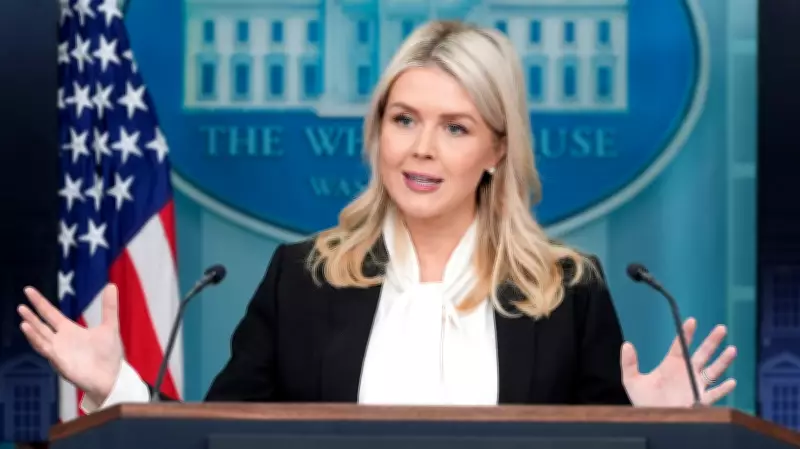
White House press secretary Karoline Leavitt became the subject of intense social media mockery on Wednesday after offering an unusual explanation for President Donald Trump's recent decision to authorize military strikes against Iran. The administration has provided multiple shifting justifications for the operation, but Leavitt introduced a new element to the discourse: essentially, vibes.
The Press Briefing Exchange
During Wednesday's press briefing, a reporter from The Independent pressed the administration on why it could not specify the exact imminent threat that prompted the United States to launch Operation Epic Fury. In response, Leavitt asserted she would clarify the president's decision-making process, which appeared to center on emotional intuition.
"This decision to launch this operation was based on a cumulative effect of various direct threats that Iran posed to the United States of America, and the president's feeling, based on fact, that Iran does pose an imminent and direct threat to the United States of America," Leavitt stated. She labeled Iran as "the world's leading state sponsor of terrorism," accused it of aggressively expanding its missile program, and claimed the nation was "hellbent on death and destruction."

She elaborated further, saying, "The president had a feeling, again, based on fact, that Iran was going to strike the United States, was going to strike our assets in the region, and he made a determination to launch Operation Epic Fury based on all of those reasons."
Social Media Backlash and Conservative Irony
The phrasing immediately triggered a wave of criticism and satire across social media platforms. Many observers noted the irony, given that conservatives, influenced by figures like podcaster Ben Shapiro, often champion the mantra that "facts don't care about your feelings." Users highlighted the apparent contradiction in justifying military action with subjective feelings.
Political commentator Michael McFaul remarked, "We went to war based on a 'feeling' that Iran was going to attack the US (even though they do not have the capacity to launch a strike against our homeland). I'm starting to think the initial explanations over the weekend for this war were better than the day-5 rationals."
Journalist Scot Lehigh criticized the administration's evolving narrative, stating, "This is what, their 4th attempt to offer a coherent rationale for this war? About all one can say is that it gets less and less convincing as they go along. Karoline Leavitt is now talking about 'feeling[s] based on fact.' What does that even mean? Give us actual facts and evidence."
Other reactions included satirical comparisons, such as user Peter Twinklage quipping, "in other words, the president felt a disturbance in the Force," and Aaron Maté referencing the Boston song to argue that warfare requires "More Than 'A Feeling.'"
Broader Implications and Public Skepticism
The incident has fueled broader skepticism about the administration's transparency and rationale for military engagement. Critics pointed out that past justifications for conflicts, like the Iraq War, involved extensive public persuasion over years, whereas this explanation seemed hastily constructed and emotionally driven.
User Ally Sammarco highlighted potential gender biases, questioning, "Can you imagine the Republican reaction if a woman president said she went to war because she had a 'feeling'?" Meanwhile, Mike Rothschild drew a stark analogy, noting, "A president attacking another country based on a feeling is unacceptable. It's like Alex Jones saying God called on him to expose the deep state while he was eating a chicken fried steak. Except people are dying because of it."
As the administration continues to navigate the fallout, the episode underscores the challenges of communicating national security decisions in an era of rapid social media scrutiny and demands for factual clarity.