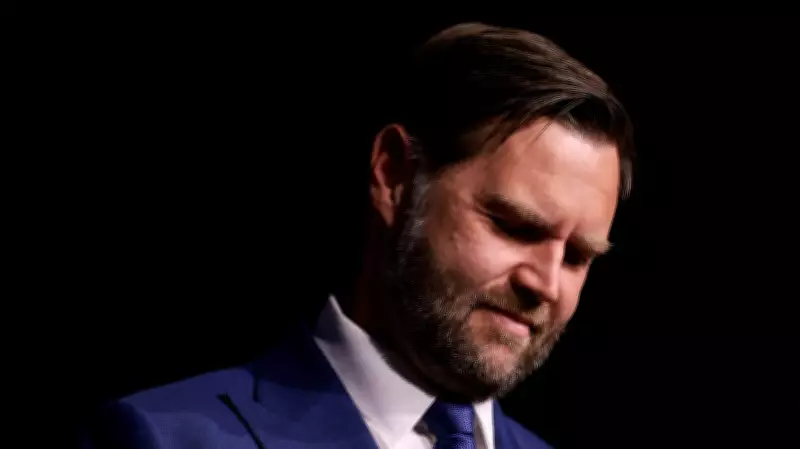
Vice President JD Vance's challenging week took another unfortunate turn on Monday night following a significant misstep during his interview on Fox News with host Bret Baier. The incident has ignited a fierce debate over U.S. foreign policy and its characterization in international discourse.
The Controversial Exchange
During the televised conversation, Vance attempted to articulate the administration's position regarding Iran's decision to block the strategic Strait of Hormuz. He labeled this action as "economic terrorism" against global interests while defending the United States' reciprocal measures.
"As the president of the United States demonstrated, two can participate in that game," Vance stated. "If the Iranians intend to pursue economic terrorism, we will adhere to a straightforward principle: no Iranian vessels will depart either. We recognize this carries substantial significance for them."

Unintended Admission or Strategic Blunder?
Critics were quick to highlight that Vance's phrasing appeared to inadvertently acknowledge that the United States was engaging in similar conduct. By framing the U.S. response as participating in the "same game" of economic terrorism, the vice president provided ammunition to political opponents and policy analysts alike.
This type of political mistake has been categorized by media observers as a "Kinsley gaffe," named after journalist Michael Kinsley. The term describes situations where politicians accidentally reveal uncomfortable truths through poorly chosen words.
Social Media Reaction
The interview segment rapidly circulated across social media platforms, generating substantial commentary from various perspectives:
- Political commentator Carolina Lion remarked: "I appreciate how Vance lacks the awareness to avoid admitting on national television that their current government policy constitutes economic terrorism."
- Journalist Prem Thakker questioned: "Does he comprehend what he just acknowledged?"
- Former diplomat Michael McFaul expressed concern: "I don't desire my nation to emulate Iranian authoritarian regimes by participating in the 'game' of 'economic terrorism against the entire world.' I believed we aspired to superior standards."
- Policy analyst Assal Rad noted: "American sanctions have systematically devastated multiple national economies, impoverishing millions of innocent civilians. That represents the precise definition of economic terrorism."
- Political observer John Jackson criticized: "What? We're also practicing economic terrorism? This represents remarkably foolish rhetoric. These are distinct concepts articulated in an exceptionally poor manner."
Broader Policy Context
The social media discussion expanded beyond Vance's specific comments to address wider concerns about U.S. economic sanctions. One commentator identified as Tiberius argued: "The United States condemning 'economic terrorism' represents another moment of irrationality when they historically constitute the most significant economic terrorists globally. American sanctions have impacted over one-third of Earth's population—restricting food, medicine, and commerce on an unprecedented scale."
Journalist John Harwood offered a succinct summary: "'I can be a terrorist too!'"
Compounding Political Challenges
This interview misstep occurred during a particularly sensitive period for the vice president. The previous week, Vance traveled to Hungary to support autocratic leader Viktor Orbán, a known ally of Russian President Vladimir Putin, only to witness his preferred candidate lose to opponent Péter Magyar.
Additionally, diplomatic efforts proved unsuccessful as Vance failed to negotiate a permanent ceasefire agreement with Iran during meetings held in Pakistan last week. These consecutive setbacks have placed the vice president under increased political scrutiny as he navigates complex international relationships and domestic policy debates.
The Fox News interview has consequently amplified existing criticisms of the administration's foreign policy approach, particularly regarding economic sanctions and their humanitarian consequences. As the political fallout continues to develop, analysts will monitor how the administration addresses these perceived contradictions in its international economic strategy.