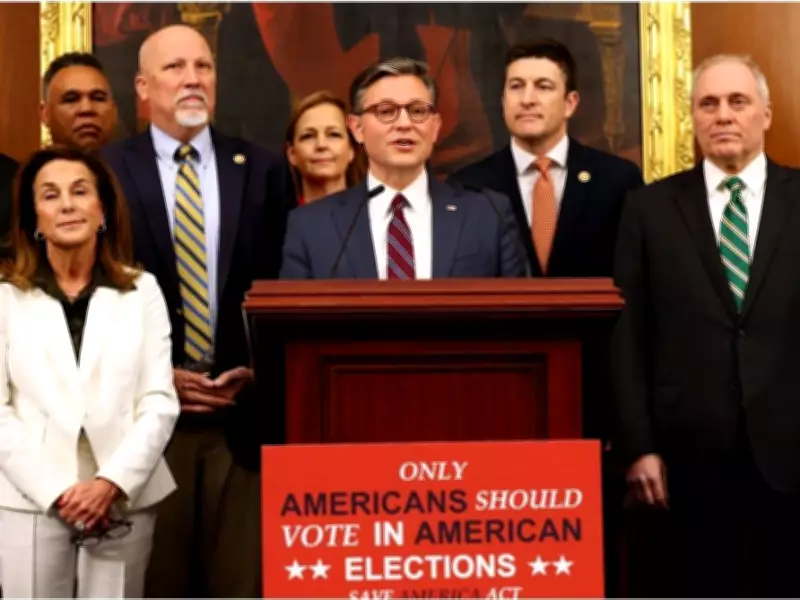
The U.S. House of Representatives is poised to approve the SAVE America Act, a significant piece of legislation that mandates proof of citizenship for voter registration and requires photo identification at polling stations. Backed by President Donald Trump and championed by House Speaker Mike Johnson alongside other Republican leaders, the bill now faces a critical hurdle in the Senate, where bipartisan support is necessary to overcome filibuster rules.
Legislative Details and Senate Challenge
Formally titled the Safeguard American Voter Eligibility Act, this proposal stipulates that individuals must provide documentation such as a REAL ID-compliant identification, passport, military ID, or a government-issued photo ID accompanied by a birth certificate or naturalization certificate when registering to vote. For mail-in registrations, in-person proof of citizenship is required, and all voters must present photo ID at the ballot box.
The Senate presents a formidable obstacle, as at least seven Democrats must join fifty-three Republicans to achieve the sixty votes needed to pass the filibuster threshold. Senate Minority Leader Chuck Schumer has vehemently opposed the measure, labeling it "an abomination, Jim Crow 2.0" and vowing to block its progression.

Public Opinion and Partisan Divides
A 2025 Pew Research survey indicates widespread public support for voter ID requirements, with eighty-three percent of respondents favoring government-issued photo identification for all voters. This sentiment breaks down along party lines, with ninety-five percent of Republicans and seventy-one percent of Democrats in favor.
Proponents argue that the bill reinforces the privilege and responsibility of American citizenship, ensuring electoral integrity. Critics, however, contend that it could disenfranchise citizens who lack the specified documentation, though the legislation includes provisions for states to establish alternative certification processes for such individuals.
Broader Implications and Political Context
The debate over the SAVE America Act reflects deeper ideological rifts regarding citizenship and governance. Supporters, including author Star Parker, frame it as a "Responsible Citizenship Act," emphasizing personal accountability in an era of expanding federal influence, where government spending has risen from approximately ten percent of GDP in the 1930s to around twenty-three percent today.
Opponents draw parallels to historical Jim Crow laws, which used tactics like poll taxes and literacy tests to suppress voting, arguing that the new requirements could similarly hinder access. A Gallup poll from last year highlights a partisan gap in national pride, with ninety-two percent of Republicans expressing extreme or very high pride in being American, compared to only thirty-six percent of Democrats.
As the legislative process unfolds, the outcome will significantly impact future U.S. elections and the ongoing discourse on voter rights versus responsibilities.