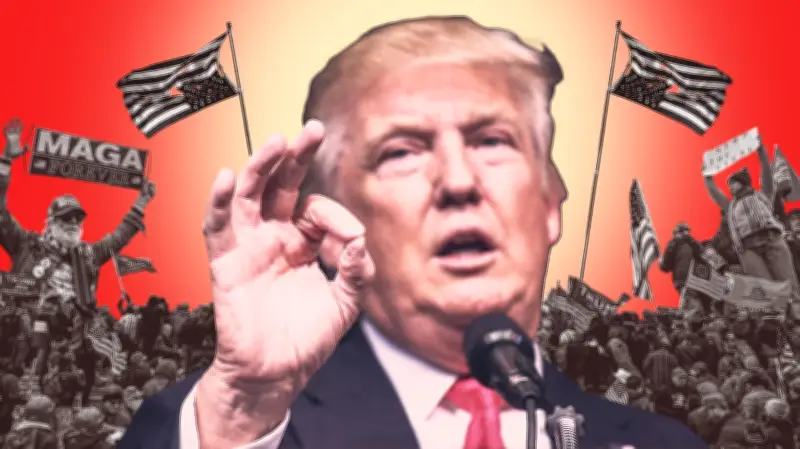
As the United States marks its 250th anniversary, it does so with a president who openly rewrites history about one of its darkest days — Jan. 6, 2021 — and embraces people convicted of seditiously conspiring against the United States. Seditious conspiracy, which involves plotting to put down the government by force or hinder the execution of laws, threatens the heart of democracy, legal experts and historians told HuffPost.
Jan. 6 Prosecutions and Pardons
Of the thousands who stormed the Capitol on Jan. 6, only 18 were charged with seditious conspiracy, all members of the far-right Oath Keepers and Proud Boys. Four pleaded guilty, and 10 others, including leaders Elmer Stewart Rhodes and Henry “Enrique” Tarrio, were convicted after months-long trials. The Justice Department under Trump has moved to wipe away those convictions entirely. On his first day back in office in 2025, Trump pardoned nearly 1,600 rioters, calling them “hostages,” and commuted Rhodes’ 18-year and Tarrio’s 22-year sentences.
Historical Context of Rebellion
“If you ask King George III, he would say the Founding Fathers were only in a position to write the U.S. Constitution because they had successfully engaged in insurrection,” said Marcus Gadson, associate professor of law at UNC Chapel Hill. “No insurrection, no treason, no rebellion, no United States, period.” But Jan. 6 was different: it marked the first time a president told a mob attacking the government, “We love you,” and did nothing for 187 minutes as the Capitol was ransacked.

From Shay’s Rebellion to the Whiskey Rebellion, rebellion has shaped American identity. The Alien and Sedition Act of 1798 banned “false, scandalous or malicious writing” against the government, but Congress let it expire by 1801. The current seditious conspiracy law, passed after World War II, focuses on plotting action against the U.S. Before Jan. 6, there were fewer than a dozen successful seditious conspiracy convictions in Justice Department history.
The Trajectory to Jan. 6
Bruce Hoffman, terrorism expert and co-author of “God, Guns and Sedition,” said Trump’s refusal to disavow far-right extremists after Charlottesville in 2017 and his 2020 call to Proud Boys to “stand back, stand by” emboldened them. “You could see this trajectory that culminates to Jan. 6,” Hoffman said. Evidence at trial showed the Proud Boys considered Trump’s remark a call to action.
The Jan. 6 investigation was the Justice Department’s largest ever. Jurors saw text messages from Proud Boys’ backchannels, heard testimony from a filmmaker who captured Rhodes and Tarrio meeting on the eve of the attack, and learned of Oath Keepers stockpiling weapons. “We saw on video these Jan. 6 attackers literally trying to prevent the execution of the laws of the United States,” said Glenn Kirschner, a former prosecutor with the Justice Department for 30 years.
Trump’s Rewriting of History
Trump was indicted in August 2023 for conspiracies tied to Jan. 6, but the Supreme Court ruled presidents have immunity for official acts, and Trump escaped liability since the Justice Department bars prosecuting sitting presidents. He has called the rioters “peaceful” and “patriots,” despite over 600 assault charges, the presence of neo-Nazi groups, and chants of “Hang Mike Pence!” He falsely claimed there were no guns, contradicting court records.
The Justice Department, now led by Trump’s former personal lawyers, fired prosecutors who worked on Jan. 6 cases and made thousands of press releases disappear. Rhodes came to the Capitol after his pardon, and Tarrio met with Trump for dinner. One pardoned rioter, Elias Irizarry, now works in a Pentagon counterterrorism department; another, former FBI agent Jared Wise, became an adviser to the Justice Department’s “weaponization working group.”

Parallels to the Lost Cause
“Rewriting history and reframing the truth of events is actually a well-worn playbook,” said Kristy Parker, former DOJ special counsel. “This is not at all unlike what we saw after the Civil War. There was a conscious, systematic decades-long effort to reframe what the Civil War was about through the Lost Cause Movement.” She warned, “The vigilance that people need to have here as we come upon our 250th birthday is to remember, validate and speak about our true history.”
Trump had planned to compensate Jan. 6 rioters from a $1.776 billion “Anti-Weaponization Fund” carved out of an IRS settlement. Although acting Attorney General Todd Blanche told Congress the fund “wasn’t moving forward,” lawyers have refused to officially shutter it. A federal judge has ordered the Justice Department to issue a clear declaration by July 17.
“The Trump administration is treating seditious conspiracy as not even worthy of accountability,” Kirschner said. “Then they try to set up a fund to pay the people who attempted to destroy our nation. It’s insanely destructive.” Gadson added that Trump’s claims of rigged elections are “deeply problematic,” warning that when people feel they can’t win through the political system, violence can follow. “Polling places historically have been places where violence has happened,” he said. “When you give free rein to violent impulses, it can have really negative ramifications.”