

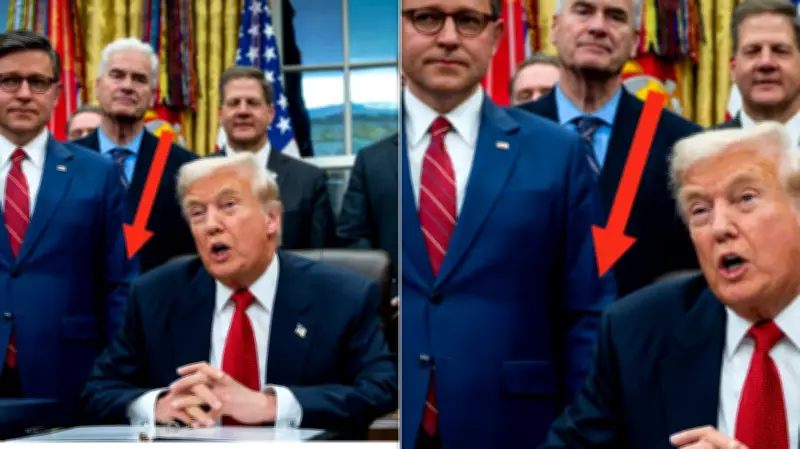
Body Language Experts Decode Trump's Defensive Posture on Epstein Inquiries
President Donald Trump continues to face persistent questions regarding Jeffrey Epstein, with his recorded responses throughout 2025 and 2026 revealing a pattern of deflection and dismissal. From former advisor Pam Bondi's February 2025 assurance that Epstein files were "on [her] desk to review" to Trump's November 2025 Truth Social post labeling the matter a "hoax," the president's approach has been consistently defensive. His public rift with former ally Marjorie Taylor Greene further highlighted the sensitivity surrounding this topic.
"The Democrats are trying to bring up the Jeffrey Epstein Hoax again because they'll do anything at all to deflect on how badly they've done on the Shutdown, and so many other subjects," Trump wrote in his November 12, 2025 post. "Only a very bad, or stupid, Republican would fall into that trap."
Nonverbal Communication Under Scrutiny
By 2026, with partially redacted Epstein files publicly available and mentioning Trump thousands of times, body language experts have analyzed the president's nonverbal communication when confronted with questions about the case. Despite Trump's claims that the latest release "absolves" him, his insistence that people "move on" from the case coincides with revealing physical cues that experts interpret as defensive and evasive.

The first significant interaction occurred on July 8, 2025, during a cabinet meeting when Trump was asked about reports claiming Epstein had "no client list." Body Language Expert Traci Brown noted: "He gives the universal sign for stop at the very beginning with both palms out. He says he doesn't have time to talk about it then goes on and on talking about how bad the question is."
Patti Wood, another body language specialist, observed Trump's unusual deferral to Pam Bondi: "He starts to respond but then he looks at Pam Bondi—and it's what I call a 'rescue look.' He tries to defer, which differs from his normal strategy of giving a nonresponse and attacking the reporter."
Contradictory Verbal and Physical Cues
During a July 15, 2025 exchange at Joint Base Andrews, Trump expressed confusion about public fascination with the Epstein case while displaying contradictory body language. "Why they would be so interested? He's dead for a long time," Trump stated, adding that the case was "pretty boring stuff. It's sordid, but it's boring."
Brown noted Trump's unusual timing: "The big tell is that Trump starts answering the question before the reporter is finished talking. That's a change in his usual baseline. Most often he waits." Wood observed his immediate head-shake "no" and distinctive facial expression: "He does a crooked sneer. The sneer goes all the way up. Part of that body language is the nose crinkles with the mouth, his upper lip goes up, showing his front teeth."
Experts found particular significance in Trump's lip movements. "He sucks his lips in after he says he doesn't understand the fascination," Brown explained, noting this gesture typically indicates "holding back info or emotions." Wood highlighted the rhetorical contradiction in Trump describing the case as both "sordid" and "boring," calling it "fascinating" that "he can't help mention that it's sordid, which is the opposite of boring."
Aggressive Responses and Protective Positioning
During a July 31, 2025 event featuring the signing of an executive order restarting the Presidential Fitness Test, Trump responded to questions about Epstein allegedly taking young women from Mar-a-Lago with what Wood described as a "death glare." "He gives a death glare to the reporter and his mouth is in a small, crooked frown," Wood said. "It's scary to think what that reporter felt."
Wood noted multiple stress indicators: "As the question proceeds, he blinks, he shutters his eyes, which means you're blocking the question, you don't want the question. His head pulls back quickly and then his whole body kind of jumps back. He does what's called a 'body adjustment,' meaning he moves around in stress." This physical retreat suggested what Wood interpreted as a "flight response" in action.

The November 12, 2025 government shutdown bill signing revealed another telling pattern: Trump's consistent physical proximity to team members. Wood observed that Trump is "never alone" in these situations, with team members positioned unusually close. "They're in that close zone of space. If you look at those pictures, they're overlapping body language with him shoulder to shoulder. That is so highly unusual, it could indicate they might need to not just protect him, but hold him up."
Patterns of Deflection and Attack
Following a February 2026 exchange with CNN's Kaitlan Collins about justice for Epstein's victims, Wood noted Trump's energy shift when transitioning to attack mode. "The voice, the volume level and the strength goes down at the end of the sentences when he first started talking," Wood explained. "It was only when he started attacking her that there was strength and energy in his voice."
Wood analyzed Trump's finger-pointing gesture as a "symbolic weapon," saying "He's poking her, he's stabbing at her." She connected this behavior pattern to the subject matter: "In rhetorical analysis, the whole question was about the Epstein files, the entire subject is on hurting young people. It's telling that he feels power over the young. It's hard to say, but it's clear non-verbally."
Throughout these interactions, experts consistently observed Trump employing defensive body language—from palm-out "stop" gestures to physical retreats and aggressive facial expressions—when questioned about Epstein, suggesting discomfort with the topic despite his verbal dismissals.





