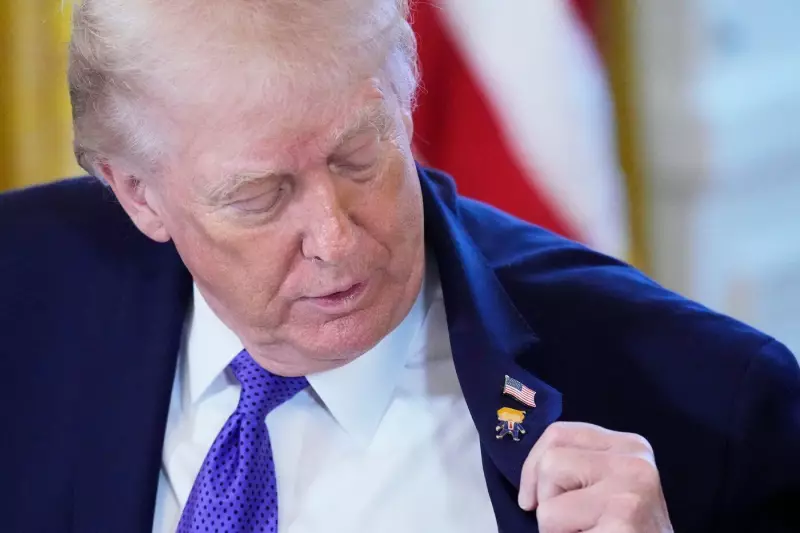
In a moment of striking contradiction, U.S. President Donald Trump displayed a new piece of jewelry while simultaneously denying the very emotion it was meant to represent. The incident occurred during a meeting with oil industry leaders at the White House on Friday, January 9, 2026.
The Pin and the Denial
Photographers in the East Room of the White House captured President Trump wearing a distinctive lapel pin. He later identified the accessory as a gift, calling it a "Happy Trump" pin. The pin was prominently visible as he engaged with executives from the American oil sector.
However, in remarks following the meeting, President Trump made a statement that directly contradicted the pin's cheerful message. He insisted that he is "never happy," creating an immediate and puzzling juxtaposition between his chosen adornment and his declared emotional state.

Context of the Meeting
The meeting itself was focused on energy policy and investment. During the discussions, President Trump made a significant promise to the assembled oil executives. He assured them of "total safety" for their investments in Venezuela, following the recent ouster of that country's leader, Nicolás Maduro.
This pledge underscores the administration's ongoing efforts to reshape global energy markets and secure advantageous positions for U.S. corporate interests abroad. The promise of stability in a nation with vast oil reserves is a major geopolitical and economic play.
A Pattern of Contradictory Messaging
This event is not an isolated incident in Trump's political communication style. Throughout his career, he has frequently utilized symbolism and rhetoric that can appear at odds with his stated positions or actions. The "Happy Trump" pin episode fits into a broader pattern where visual messaging and verbal declarations diverge.
Political analysts often scrutinize such moments for insights into strategy or public perception management. The choice to wear a pin suggesting happiness while verbally rejecting the sentiment raises questions about the intended audience for each message—the visual for the cameras and the public, and the verbal for a different narrative.
Reactions and Implications
While the immediate Canadian news cycle was dominated by domestic stories—from job losses in Saskatchewan to a family doctor shortage warning in Ontario—this moment from Washington did not go unnoticed. It adds another layer to the complex portrait of a U.S. president who continues to dominate headlines with his unorthodox approach.
The incident also occurred against a backdrop of other international news involving the United States, including Canada condemning Russia's use of hypersonic missiles in Ukraine and criticism of U.S. plans regarding Greenland. Trump's actions and statements remain a focal point for allies and observers north of the border, given the deep economic and political ties between the two nations.
As the 2026 political landscape takes shape, moments like these contribute to the ongoing analysis of leadership style, diplomatic relations, and the unpredictable nature of current American politics. The "Happy Trump" pin will likely be remembered as a small but symbolic footnote in a presidency defined by its contradictions.