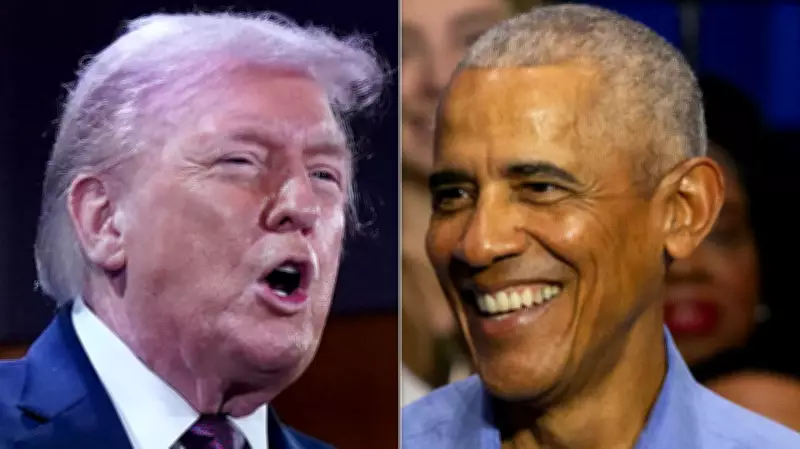
Trump's Social Media Post Featuring Racist Imagery of Obamas Draws Fierce Condemnation
Former President Donald Trump faced intense criticism on Friday after he engaged in a social media-sharing spree on his Truth Social platform. The controversy centered on a 62-second video clip that included footage depicting former President Barack Obama and former First Lady Michelle Obama as primates, with their faces superimposed on the animals' bodies. The video, set to the song "The Lion Sleeps Tonight," briefly cuts at the 59-second mark to show the offensive imagery.
Reviving Baseless Conspiracy Theories
This incident is not Trump's first foray into promoting racist narratives about Barack Obama. For years, Trump has amplified the debunked and racist birther theory, which falsely claimed Obama was not born in the United States and was therefore an illegitimate president. Critics argue that this latest video posting demonstrates a disturbing pattern of behavior, with many stating that "there's no bottom" to Trump's actions.
Political and Public Figures Voice Outrage
The backlash was swift and severe from various quarters. California Governor Gavin Newsom's press office issued a strong statement, labeling Trump's behavior as "disgusting" and calling on "every single Republican" to denounce it immediately. Other prominent figures echoed this sentiment, expressing shock and dismay at the president's conduct.

Ben Rhodes, a former deputy national security advisor, suggested that history will judge Trump harshly, while future Americans will embrace the Obamas as beloved figures. Shevrin Jones, Nate Pyle, Kevin Baron, and Kay Burley all condemned the video, with some noting the irony of its timing during Black History Month. Legal commentator George Conway also referenced previous writings on similar subjects, highlighting the ongoing nature of such controversies.
Broader Implications for Political Discourse
This event underscores the volatile intersection of social media, politics, and racial insensitivity in contemporary public life. The use of primate imagery to depict Black individuals has a long and painful history rooted in racist stereotypes, making Trump's post particularly inflammatory. As the 2026 political landscape continues to evolve, incidents like this raise questions about accountability, decorum, and the normalization of hateful rhetoric in digital spaces.
The widespread condemnation from both Democrats and some Republicans indicates a growing unwillingness to tolerate such behavior, even from high-profile figures. However, the response also reveals deep divisions in how political actions are perceived and addressed across the ideological spectrum.