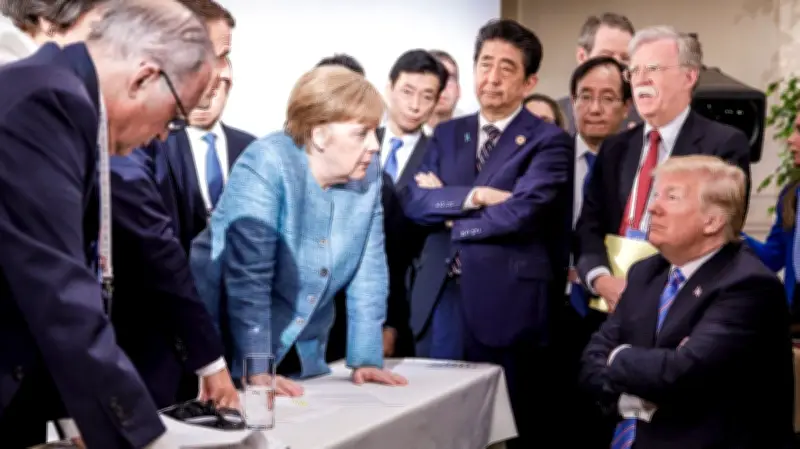
President Donald Trump boards Air Force One on June 15, 2026, at Joint Base Andrews, Maryland, traveling to France for the G7 Summit. The meeting comes as Trump has been disparaging America's allies for refusing to participate in his war against Iran.
G7 Summit: A Clash of Wills
Trump is set to arrive at the Group of Seven summit, where the other six members have been on the receiving end of his insults for not sending ships and planes to the Persian Gulf to help reopen the Strait of Hormuz. The war has caused a global energy crisis, and allies are likely as irritated with Trump as he is with them.
French President Emmanuel Macron, the host, has been open in his criticism of Trump's war. "President Trump will be there, and President Macron will be the host," said Ian Lesser, a foreign policy expert with the German Marshall Fund. "Normally these things are not unpredictable events. This could be quite different."

The meeting runs through Wednesday and will be followed by a NATO summit in Turkey. Trump has repeatedly threatened to pull out of the alliance, whose members declined to participate in the war Trump and Israeli Prime Minister Benjamin Netanyahu began on Feb. 28.
Allies Rethinking Reliance on U.S.
Doug Lute, a retired Army general and former U.S. ambassador to NATO, said allies who once thought of Americans as reliable partners are trying to "de-risk" summits and rethink their assumption that they can count on the U.S. in a crisis. "They're going to move on from us," he said. "The U.S. is walking away from international groups that have served other presidents of both parties well for several generations."
Creon Butler, a top architect of the British government's G7 participation during Trump's first term, uses the phrase "the Trump Shock" to describe the thinking by America's traditional allies. "There's a kind of an understanding among G7 partners that there is a shift in the U.S. Things are not going to go back where they were."
The Adults Are Gone
During Trump's first term, top aides like former Vice President Mike Pence and national security adviser H.R. McMaster worked to assuage allies. Former Defense Secretary James Mattis joked that his role was the "Secretary of Reassurance." In this second term, those voices are replaced by Vice President JD Vance and Defense Secretary Pete Hegseth, both even more antagonistic. Hegseth, during a D-Day commemoration, likened the Allied storming of Normandy to the arrival of migrants in Europe today.
Jim Townsend, a former Pentagon official, said Trump will likely say or do things for maximum disruption. "When he goes to these things, he likes to say things to 'own the libs,' as it were. He likes being the enfant terrible."
Trump has said little about his goals for the G7, other than announcing his attendance after hosting UFC fights at the White House for his 80th birthday.
Macron's Criticism and Trump's Response
Macron publicly lashed out at Trump during a visit to South Korea, saying "Ce n'est pas un spectacle!" and questioning the purpose of the war. Trump did not heed Macron's advice, posting on social media that Iran's civilization "will die tonight, never to be brought back again."
Threatening an Ally
The real breaking point came when Trump claimed a right to take control of Greenland, a territory of Denmark, a NATO and EU member. Trump refused to rule out using military force, leading five NATO nations to stage joint military exercises in Greenland without the U.S. Townsend said at a Paris conference, "That's just Trump's crazy talk. But that's not how it's looked on here, at all."
Trump later declared at the World Economic Forum in Davos that he would not use military force to seize Greenland, but expressed irritation that Denmark was not handing it over. "How ungrateful are they now? We never asked for anything and we never got anything."

Iran War Strains Alliances
Trump launched a major air war against Iran, prompting Iranians to close off the Strait of Hormuz, through which a fifth of the world's crude oil passes. Oil prices spiked worldwide. None of the G7 partners were consulted, but Trump insisted they help with troops, planes, and ships. When none volunteered, Trump wrote on social media: "All of those countries that can't get jet fuel because of the Strait of Hormuz... go to the Strait, and just TAKE IT." He added, "France has been VERY UNHELPFUL... The U.S.A. will REMEMBER!!!"
Re-thinking Decades of Alliances
Macron's agenda for the G7 seeks "reduction in global inequalities" and protection of "the rights of LGBT people," goals Trump has not supported. At his first G7 in Taormina, Italy, Trump followed in a golf cart while other leaders walked. In 2018, Trump refused to sign a joint communiqué, and in 2019, he pushed to readmit Russia.
Last year, Trump left the G7 early to focus on the air attack on Iran's nuclear sites. This time, allies are planning to "de-risk" encounters, avoiding a joint communiqué and instead producing less ambitious statements. Macron has invited Trump to dinner at Versailles.
Lute said, "They will not aim for any sort of joint communiqué. Because it's impossible, with this guy. NATO will do the same thing. They're down to damage limitation: 'Let's just try to get through this.'"
Townsend added that if Trump cannot get help for his war, he may generate content for his fanbase, accelerating efforts by Europe and others to decouple from the U.S. "They don't want to be connected at the hip with someone who is irrational and unpredictable. People from abroad are shaking their heads and asking, 'What is wrong with you all?'"