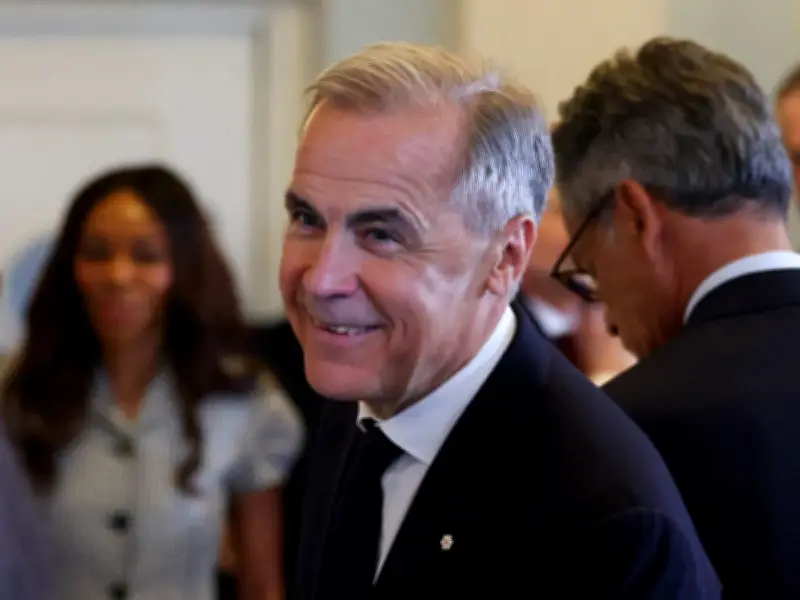
As the Canada-United States trade talks launch into an uncertain trajectory, the ability of Canadian voters and foreign observers to determine where Prime Minister Mark Carney stands on national and international issues has become a little like reading the mind of a stock market. It could go either way.
Within his own Liberal party, murky political battle lines have been formed around contradictory policy stances on climate change, fossil fuels, trade and relations with the United States.
Where Does Carney Stand on Climate and Fossil Fuels?
In his Memorandum of Understanding (MOU) with Alberta Premier Danielle Smith, Carney simultaneously endorses increased oil production while pretending to reduce carbon emissions. Or, as viewed from the other side, he is pretending to boost fossil fuels while introducing uneconomic proposals to capture carbon emissions with industrial carbon taxes.

Carney's approach to relations with the United States is equally confusing. In his widely cited speech last week in New York, Carney told a business audience about how Canada and the United States can 'consolidate our strengths' and 'work together and compete with the rest of the world.' And then he bent his knee to President Donald Trump: 'Canada Strong will help make America great again.'
Too few observers have acknowledged the contradictions and tonal inconsistencies with Carney's earlier claims that Canada was ready to sever trade and other ties with the United States. A year ago, Carney proclaimed Canada's old relationship with the U.S. 'over.' Only a few weeks ago he reiterated this approach in a video posted on YouTube: 'The U.S. has changed' and Canada must look elsewhere for economic and political security, he said. 'Many of our former strengths, based on our close ties to America, have become our weaknesses, weaknesses that we must correct.'
Also in his New York comments last week, Carney the anti-fossil fuelist played another fossil fuel tune. Canada will increase liquid natural gas (LNG) exports to 50 million tons by 2030 and 100 million by 2040. That's a lot of LNG production, a disturbing forecast for environmentalists who claim the production and transport cycle for LNG produces more carbon emissions than coal.
No wonder former environment minister Steven Guilbeault has left the Liberal caucus and ex natural resources minister Jonathan Wilkinson has left Parliament. They have joined a line of activists, politicians and journalists who view Carney's strategy as a betrayal. Writing in The Guardian, Vancouver climate journalist Seth Klein captured the shift in sentiment. 'Canadian prime minister Mark Carney is not the climate guy you thought.' Carney's signing of the pipeline MOU is another policy flip that will increase Canada's carbon emissions, he said. However, 'The Canadian climate movement is getting its bearings back,' Klein claimed.
Among the movement's leaders getting back into action is Rick Smith, head of the Canadian Climate Institute. When Carney became PM, Smith hailed an opportunity for Canada to establish a clear climate policy. 'Accelerating Canada's progress on climate change is an economic imperative in this time of global economic upheaval and uncertainty,' he said.