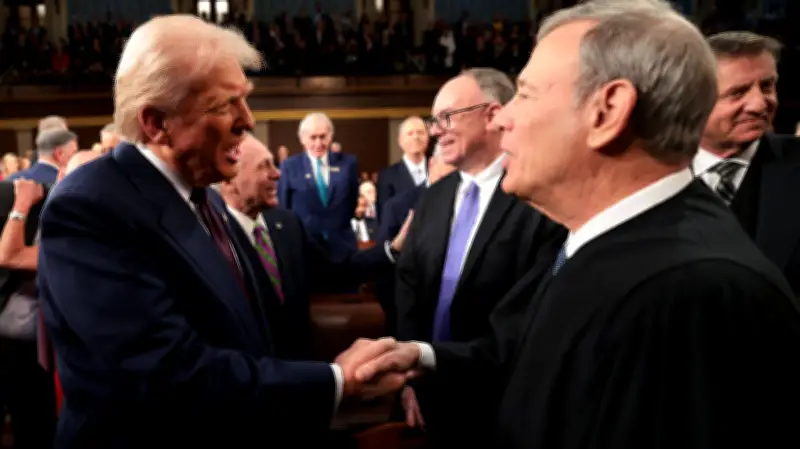
In June, the Supreme Court handed down its decision in Trump v. Slaughter, enabling the president to fire independent agency officials for any reason. This decision, overturning decades-old precedent insulating such agencies from direct presidential control, marked the full embrace of unitary executive theory, whereby all executive power is exercised by the president.
President Donald Trump hailed the court's ruling as "the Greatest Increase in Presidential Power in the last 100 years": He was now gifted the power to fire officials who issue regulations and take enforcement actions that did not abide by his policy directions. Conservatives rejoiced. But could this be a double-edged sword? In theory, a future Democratic president would also have the ability to purge agency officials who don't do as they demand, thus enabling an expansion of regulation and enforcement — but perhaps in a liberal direction this time.
Major Questions Doctrine Blocks Democratic Regulation
But 2028 contenders should perhaps not get their hopes up. The reality is that a Democratic president can try, but they would run into a buzzsaw from the courts. That's because the conservative-dominated court has developed and imposed a made-up doctrine, known as the major questions doctrine, to block any future regulatory or enforcement actions a Democratic president could order a formerly independent agency to enact. When combined with the new power to fire agency officials for any reason, the court has tilted power not just in favor of presidents, but also in favor of Republicans' deregulatory agenda.

This tilt works by making it easier for a president to stop an agency from functioning or issuing regulations, while simultaneously putting up roadblocks for any new regulation.
Removal Power and Senate Confirmation Hurdles
It begins with the new removal power: A Democratic president can now remove officials who stand in their way, but if they want to put in new officials, they may face the obstacle of a Republican-controlled Senate. A Republican president could face the same problems with a Democrat-controlled Senate, but appointing new officials wouldn't be a dealbreaker. As Trump has done, they could simply fire officials to disable an agency by denying it a quorum to issue rules or take enforcement actions.
"If the bureaucracy doesn't work, that's a position that favors Republicans," said Graham Steele, former assistant secretary for financial institutions at the Treasury Department during the Biden administration.
Major Questions Doctrine in Practice
Even if a Democratic president gets their appointees confirmed, the major questions doctrine will come into play. The major questions doctrine, an unofficial guidance that the courts began using in earnest with the 2022 decision in West Virginia v. EPA, states that any regulatory action of "vast economic and political significance" must have "clear congressional authorization" or else the court will find it is an unconstitutional delegation of legislative power to the executive branch.
During President Joe Biden's term, the court used this doctrine to strike down initiatives regulating greenhouse gas emissions, a pandemic-era eviction moratorium, vaccine mandates for federal contractors, and student loan forgiveness. Lower courts also invoked the doctrine dozens of times to strike at similar Biden regulatory efforts.
A future Democratic president could expand their reach across the executive branch by using the powers granted under the court's Slaughter decision, but will likely face the same, or greater, scrutiny under the major questions doctrine as Biden did.
"It's a trump card for any kind of regulation an agency could do," Steele said. "It loads the dice in favor of regulatory inaction and against agencies that are trying to enact a robust agenda."

Impact on Emerging Industries
Steele points to his experience in the Biden administration working to update anti-redlining regulations under the Community Reinvestment Act, and "trying to apply new frameworks to a new and evolving industry." These changes, meant to adjust rules aimed at preventing discrimination in housing to the new realities of digital banking, were struck down by a lower court in Texas under the major questions doctrine. (The Trump administration reversed the Biden-era rule change before an appeal reached the Supreme Court.)
It's an example of how future action on the regulation of new and emerging industries, such as artificial intelligence, could be killed before they are born. "It's a deregulatory Swiss Army knife where a judge can pick and choose on what grounds they want to invalidate a particular regulation," Steele said.
Conservative Justices Signal Further Restrictions
The conservative justices haven't been shy about hinting that certain areas of regulation are ripe for future restrictions. In Slaughter, Chief Justice John Roberts, the author of the majority opinion, called the Federal Trade Commission's regulation of "acts or practices which are unfair or deceptive," a "startlingly abstract idea."
Justice Neil Gorsuch similarly went after the FTC's regulation of "unfair or deceptive" practices as an example of agencies acting "with hardly any statutory guidance, based on broad grants of legislative authority." This came in a concurrence in which Gorsuch continued his crusade to revive the pre-New Deal nondelegation doctrine, which would disable nearly all agency regulatory authority.
What the court has done by expanding the president's removal power while restricting the president's ability to dictate policy to officials to be solely deregulatory is to stack the deck against Democrats or any party that favors a regulatory agenda.
Judicial Empowerment Over Both Branches
It also empowers the judiciary over both branches. By expanding the president's removal power, the court limited Congress' ability to structure executive agencies by protecting officials from firing at the president's whim. And through the use of the major questions doctrine, the court claims the power to dictate what rules those officials may issue.
As Democrats begin to discuss how they would govern if they win back control of the White House in 2028, the courts' heavy hand on the scales of executive branch structure and regulatory policy stands waiting as a major obstacle to any unilateral presidential action.
"An important lesson learned from the Biden administration was that if a court starts issuing decisions that look like blatant partisanship, you have to be willing to call them out and make them a villain in the whole enterprise," Steele said. "There was a lot of concern about attacking the judiciary and trying to undermine their independence and being political with the courts. But if you want to be successful in politics, you have to actually identify what is the obstacle to the president's agenda being enacted, and be willing to call that out."