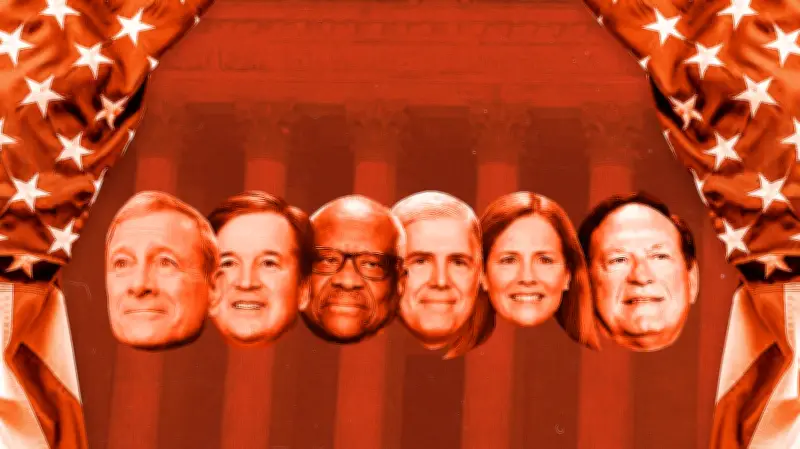
The Supreme Court's final ruling of the term upheld birthright citizenship, blocking President Donald Trump from denying citizenship to people born on U.S. soil. Chief Justice John Roberts wrote in the majority opinion: "The Framers of the Fourteenth Amendment extended that promise to 'every free-born person in this land.' We keep that promise today."
Hypocrisy in Other Rulings
However, the term also included decisions that critics say reveal hypocrisy and a legitimacy crisis. The court gave the president nearly unfettered power to fire independent agency officials, upending 90 years of precedent. It removed limits on campaign spending coordination, allowing more corporate and billionaire influence. It upheld a ban on trans girls' and women's participation in sports, with justices disparaging transgender identity as a "lie to the public."
Stasha Rhodes, executive director of United for Democracy, told HuffPost: "The court creates just enough distance from the administration on a single case to preserve the appearance of balance while the underlying patterns continue to change."

Declining Public Approval
Supreme Court approval has fallen from roughly 70% five years ago to under half today. Justices Amy Coney Barrett and Samuel Alito blamed the media, but Rhodes said: "That’s not a partisan talking point. That’s the country looking at this institution in real time and seeing that something fundamental has changed about what it is and who it serves."
Rhodes distinguished disapproval from legitimacy: "Disapproval means people don’t like the outcomes. Legitimacy means people no longer believe the institution is playing it straight."
Birthright Citizenship Case
The birthright citizenship ruling illustrated this. While many were happy the 14th Amendment was upheld, Rhodes noted how close the court came to eliminating it via executive order. The term also included Mullin v. Al Otro Lado and Mullin v. Doe, which gutted asylum protections and upheld a racist decision to strip temporary protection status from 400,000 people fleeing violence and poverty. Alito dismissed racism as a change in political talk, refusing to repeat Trump's statements about Haitians.
Lisa Graves, co-founder of Court Accountability, told HuffPost: "These cases are organized for release to create that sort of notion that they are being even-handed when that is not the case."
Broader Agenda
Other decisions this year embraced racial profiling for mass deportation, eviscerated the Voting Rights Act, and targeted LGBTQ+ rights, including military service, passports, and gender-affirming care. Graves said: "This court has demonstrated over and over this term its willingness to discard longstanding, well-respected legal precedents in order to accomplish this ideological agenda."
Graves argued that birthright citizenship should have been unanimous. "Instead, it was a heartbeat away from five potential judges just declaring that a president can strike out one of the most fundamental guarantees of American rights." She accused Roberts of playing "the hero" while pushing an extreme revision of law.
Need for Reform
Both Rhodes and Graves agreed reform is needed. Rhodes said: "I think Americans are feeling frustrated that we have a political system that no longer works for working families but is working really well for the powerful and well-connected."
Graves called for comprehensive reform: "We have to look at how we have ceded so much power to the Supreme Court and in the way we wait every June to see what the Oracle of Delphi will decide on whether we have rights or not."