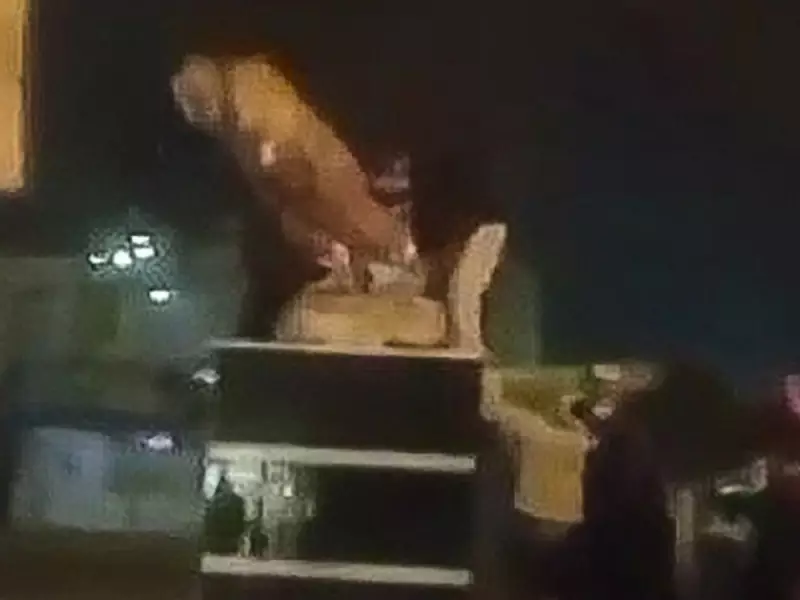
Security forces in Iran deployed tear gas to disperse demonstrators on Thursday as nationwide protests fueled by a severe economic crisis entered their 12th day. The unrest, which has evolved into a significant challenge to the country's clerical leadership, saw a symbolic escalation with protesters toppling a statue of revered military commander Qassem Soleimani.
Symbolic Act Defies State Narrative
In a powerful act of defiance, protesters in the town of Kuhchenar, located in the southern Fars province, cheered as they pulled down a statue of Qassem Soleimani. The former commander of the Revolutionary Guards' Quds Force was killed in a U.S. drone strike in January 2020 and is officially celebrated as a national hero by the Islamic Republic. Video of the incident was published by the HRANA monitor, highlighting the protesters' direct challenge to state symbols of power and unity.
The protests, which have now spread to all 31 of Iran's provinces, began on December 28 following a shutdown of the historic Tehran bazaar. This initial action was triggered by the Iranian rial plunging to record lows, exacerbating long-standing economic hardships caused by years of international sanctions and the aftermath of the June war against Israel.

Nationwide Unrest and Government Crackdown
According to the HRANA monitor, demonstrations have been recorded in at least 348 locations over the past 11 days. The movement has grown from localized merchant protests to larger-scale public demonstrations. In one verified video, hundreds of people marched down a main avenue in the northeastern city of Bojnord on Wednesday.
The government's response has been harsh. Authorities have labeled participants as "rioters," and judiciary chief Gholamhossein Mohseni-Ejei has vowed there would be "no leniency" in prosecuting them. The Norway-based Iran Human Rights (IHR) group reported that security forces opened fire on protesters, used tear gas, and violently assaulted civilians during a demonstration in the southeastern city of Kerman on Wednesday. The group confirmed that at least 27 protesters, including five teenagers under 18, have been killed in the crackdown, warning the death toll is likely to rise.
In a separate incident highlighting the violence, an Iranian police officer was stabbed to death near Tehran on Wednesday "during efforts to control unrest," according to the Fars news agency.
Exiled Opposition Calls for Escalation
Key exiled opposition figure Reza Pahlavi, son of the Shah overthrown in the 1979 revolution, has sought to galvanize the protesters. He described Wednesday's turnout as "unprecedented" and called for major new demonstrations on Thursday evening. In a social media message, Pahlavi claimed the regime was "deeply frightened" and attempting to cut off the internet to thwart organizing efforts.
Chants heard during the protests directly target the country's leadership. Demonstrators have been heard repeating slogans such as "this is the final battle, Pahlavi will return" and "Seyyed Ali will be toppled," a direct reference to Supreme Leader Ayatollah Ali Khamenei.
As the protests continue to evolve, they represent one of the most sustained and geographically widespread challenges to Iran's authorities in recent years, directly linking economic despair with political dissent and targeting the very icons of the state's power.