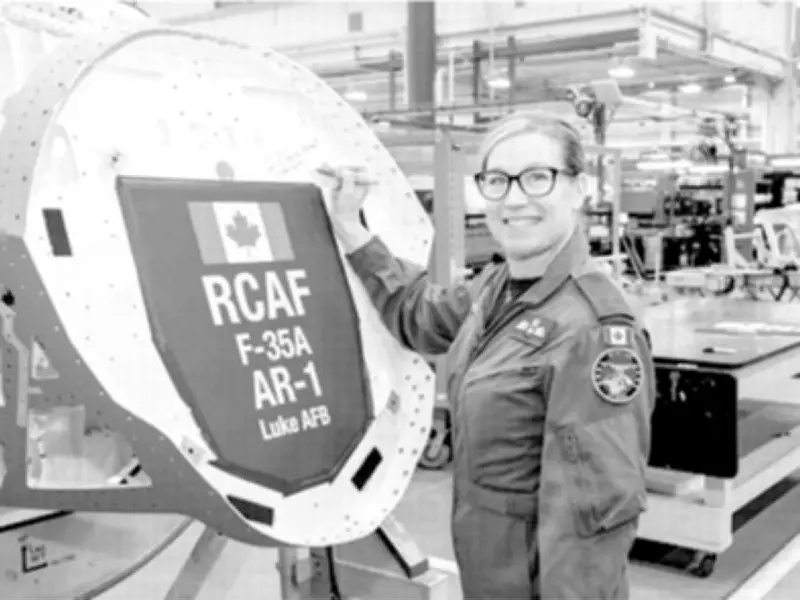
Somewhere, possibly locked in a vault at Department of National Defence headquarters, lies one of the rarest recent photos involving the Canadian Forces. The image shows RCAF commander Lt.-Gen. Jamie Speiser-Blanchet signing part of the fuselage of Canada's first F-35 fighter jet during a ceremony at Lockheed Martin's Fort Worth, Texas, facility on Feb. 2. The Ottawa Citizen has obtained a grainy black-and-white photocopy of the photo through an access-to-information request, but the military did not make it easy to obtain, and a high-resolution colour version remains elusive.
The saga of the controversial photo
The controversy comes at a time when Defence Minister David McGuinty faces increasing criticism for excessive secrecy in his department while it receives record funding. Usually, such a ceremony would be publicized by both Lockheed Martin and the Canadian Forces, but this signing was deemed a closed-door event. Few knew about it until CBC broke the story about Speiser-Blanchet's trip and the ceremony.
Other countries have highlighted photos of their military officers taking part in similar F-35 signings, but not Canada. The Ottawa Citizen asked the RCAF for a copy of the picture on Feb. 2, initiating a runaround. Military officials acknowledged the request and for the next month claimed they were 'looking' into the matter. Lockheed Martin Canada declined to release the image, stating that the RCAF and DND were handling distribution. After a month, the RCAF and DND simply refused to answer whether they would release the photo.

Government concerns about messaging
Government sources said at the time that the RCAF worried the ceremony would undercut Prime Minister Mark Carney's message that Canada's purchase of U.S.-built F-35s was under review. The review was part of Carney's strategy to take a tough stance against U.S. President Donald Trump's administration and reduce Canada's reliance on U.S. military equipment. Releasing a photo of a smiling Canadian general at an event highlighting the purchase of an American fighter jet did not align with government messaging.
The next step was to use an access-to-information request. The Access to Information Act allows any member of the public to request government information, which is supposed to be released within 30 working days unless requesters are officially notified and provided with valid reasons for more time. The request sought a high-resolution photo of Speiser-Blanchet signing the F-35 fuselage.
After a lengthy process, the Ottawa Citizen finally obtained a copy, though not the high-resolution version. The military's refusal to release the photo initially and the subsequent access-to-information battle highlight ongoing tensions over transparency in Canada's defence procurement and government communications.