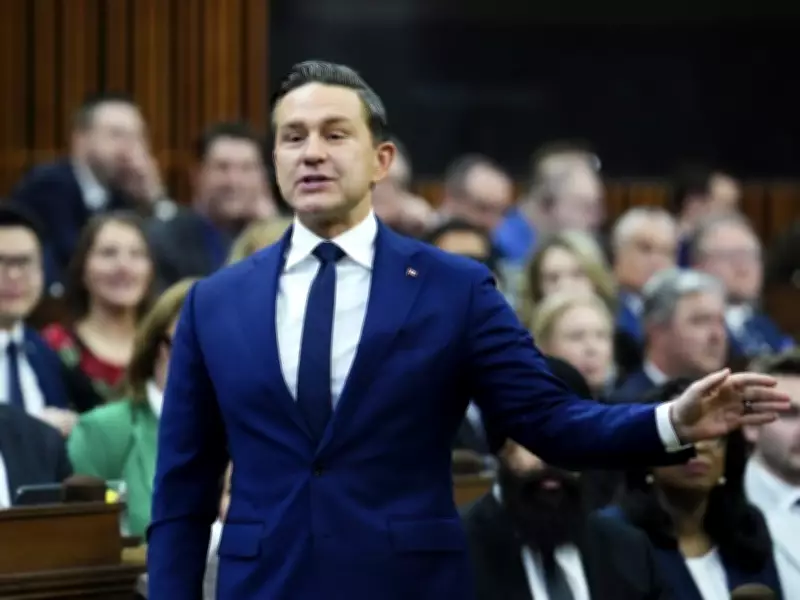
Conservative Leader Advocates for Immediate Fuel Tax Relief
Conservative Leader Pierre Poilievre has issued a strong call for the federal government to implement temporary gas tax relief measures to assist Canadian drivers facing escalating fuel costs. In a proposal unveiled recently, Poilievre urged Prime Minister Mark Carney to adopt policies that would significantly reduce the financial burden on households and businesses.
Proposed Tax Suspension and Elimination
Poilievre's plan includes two key components designed to provide immediate financial relief. First, he advocates for the suspension of both the federal excise tax and the Goods and Services Tax (GST) on gasoline and diesel until the conclusion of this year. According to Poilievre, this measure alone would save drivers approximately 18 cents per litre during each visit to the pump.
Additionally, the Conservative leader is pushing for the complete cancellation of the Clean Fuel Standard, which he characterizes as a carbon tax under a different name. Eliminating this standard would further reduce fuel costs by an estimated 8 cents per litre, resulting in a combined potential savings of 25 cents per litre for Canadian consumers.

International Comparisons and Economic Impact
Poilievre points to several nations that have already implemented similar fuel tax reductions to help their citizens cope with rising prices exacerbated by global conflicts. Countries such as Spain, Ireland, and Australia have taken proactive steps to alleviate financial pressure on their populations.
"While the Iran war explains the sudden rise in world oil prices, it does not explain why Canadians pay so much more than Americans," Poilievre stated. "Liberal taxes force Canadians to pay 28 cents-a-litre or 20 per cent more than in the United States."
The Conservative leader emphasized that these elevated fuel taxes have broader economic consequences, particularly affecting grocery prices, which he notes are increasing at the fastest rate among G7 nations.
Current Fuel Price Statistics
Recent data illustrates the dramatic increase in fuel costs across Canada:
- The average price for a litre of gasoline has surged from $1.30 at the beginning of the year to $1.78 currently, representing a 48-cent-per-litre increase.
- Diesel prices, crucial for transportation and goods movement, have climbed from $1.66 per litre to $2.31 per litre during the same period.
In comparison, the national average for gasoline in the United States converts to approximately $1.47 per litre in Canadian dollars, while diesel averages around $2.00 per litre. Poilievre attributes this significant price differential primarily to higher taxation levels in Canada.
Government Revenue and Alternative Funding
Poilievre highlighted that the federal government is currently benefiting from increased GST revenue due to higher fuel prices, collecting several million dollars daily in unanticipated windfall income. He argues that this additional revenue should be redirected to provide relief for Canadian citizens.
"Canadians deserve affordable fuel and food," Poilievre asserted. "Seniors should be able to enjoy a worry-free drive to see grandkids, parents should not stress about filling the minivan for hockey practice, and workers should be able to fill their trucks stress-free."
The Conservative leader suggested that the Carney government could finance these tax reductions by eliminating what he describes as wasteful expenditures. Specific examples he cited include:

- The unsuccessful firearm buyback program
- Excessive spending on external consultants by federal agencies
- The proposed $90-billion high-speed rail project facing substantial opposition
Provincial Precedents and Implementation Challenges
Alberta has established a provincial program that reduces fuel taxes when prices spike significantly. This mechanism activates when oil prices exceed $80 per barrel and eliminates the tax entirely when prices surpass $90 per barrel. However, despite current oil prices reaching approximately $110 per barrel, the tax relief did not commence on April 1 due to timing restrictions within the program's rules, with the next adjustment scheduled for July 1.
Poilievre's proposal faces political hurdles, as he anticipates resistance from the current administration. Nevertheless, he maintains that with gasoline prices reaching unprecedented levels, this policy initiative represents a practical solution that the prime minister should seriously consider adopting to provide tangible relief for Canadian drivers across the nation.