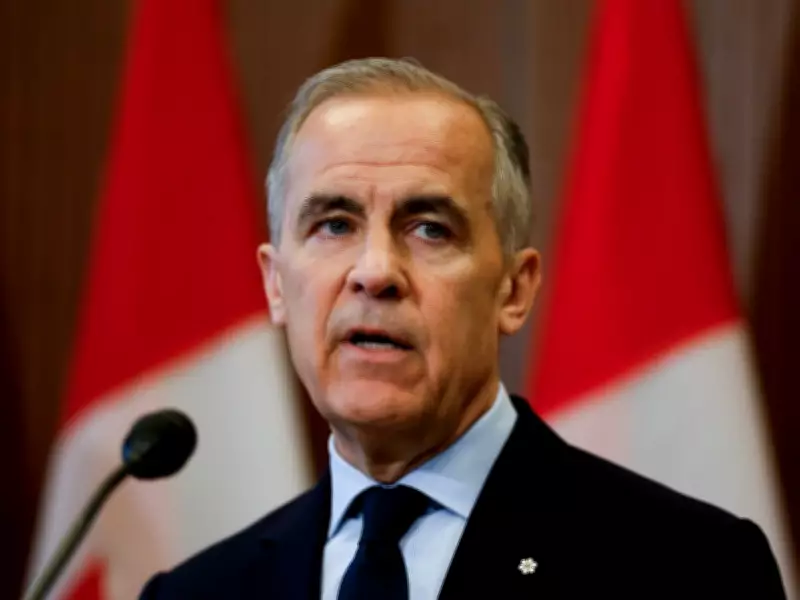
Prime Minister Mark Carney announced that the federal government is ready to help Newfoundland and Labrador Hydro negotiate a new energy agreement with Hydro-Québec, while the Quebec government expressed confidence in achieving a mutually beneficial outcome for both provinces.
Speaking in Saint-Michel-des-Saints, Quebec, Carney revealed he has held several recent discussions with the premiers of Quebec and Newfoundland and Labrador, along with his Minister of Energy and Natural Resources, Tim Hodgson. Although the matter primarily involves the two provinces and their Crown corporations, Carney signaled Ottawa's willingness to facilitate a deal.
"If there are things that we can do, we will do them," Carney stated.

These remarks came hours after the release of a report commissioned by Newfoundland and Labrador's newly elected Progressive Conservative government, which concluded that the memorandum of understanding (MOU) announced in late 2024 is not in the province's best interest. The MOU, signed by former Newfoundland and Labrador Premier Andrew Furey and former Quebec Premier François Legault, aimed to replace the contentious 1969 Churchill Falls contract that has allowed Hydro-Québec to purchase electricity from Newfoundland at a discounted rate.
The proposed deal would have increased the price Hydro-Québec pays for Newfoundland's electricity by an average of 30 times over the next 50 years. In exchange, Newfoundland would have authorized Hydro-Québec to construct two new power plants at Churchill Falls and Gull Island.
Newfoundland and Labrador Premier Tony Wakeham, who took office last year, established an independent review committee to assess the MOU. On Tuesday, he stated that "material improvements" are necessary before he would consider signing it.
"If the experience of 1969 taught us anything, it is that we must always look past the big promises and best intentions, and always, always read the fine print," Wakeham said.
The review committee's report acknowledged that the MOU offers "important financial and economic benefits for the province" until 2041, when the 1969 agreement was set to expire. However, it raised concerns about long-term economic development, highlighting "problematic" power pricing and payment models, a lack of transmission infrastructure to export Churchill Falls power, and challenges in sustaining joint ventures between partners with divergent interests.
"The committee concludes that, despite the benefits, the MOU in its current form is not in the public interest," the report stated.
The committee also argued that the MOU's total financial benefit to Newfoundland is best represented by a net present value of $31 billion, rather than the nominal $227 billion presented by the former Liberal government.