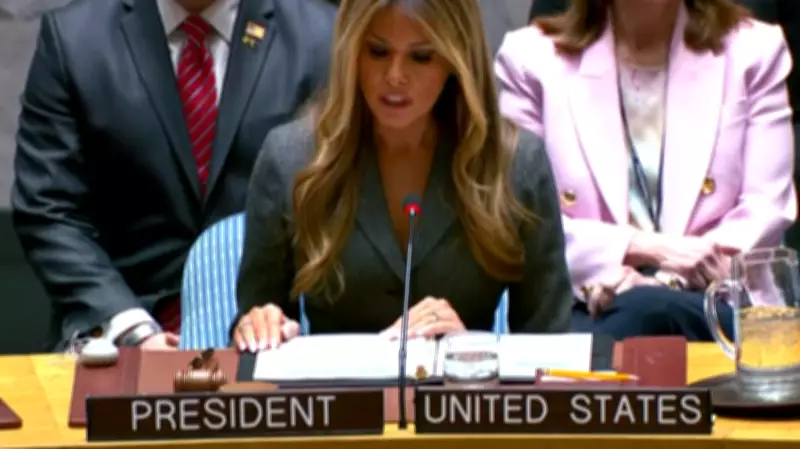
Critics expressed bewilderment and outrage over First Lady Melania Trump's appearance at the United Nations Security Council on Monday, where she delivered remarks on achieving world peace through education. The event occurred during the United States' rotating presidency of the council in March, marking the first time a first lady has ever presided over such a session.
Jarring Optics Amid Military Escalation
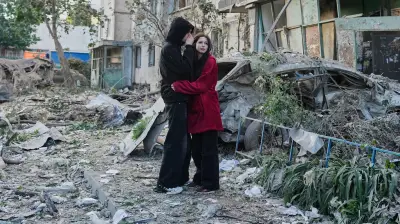
The timing proved particularly contentious, coming just two days after President Donald Trump authorized joint U.S.-Israeli military operations against Iran. Reports indicate these strikes have killed hundreds of Iranians, including 153 people when a school was hit in the town of Minab, with children among the casualties.
Melania Trump sat before nameplates reading "President" and "United States" as she opened the session before yielding to United Nations Under-Secretary-General Rosemary DiCarlo. DiCarlo noted the debate "comes at a moment of exceptional relevance" with the world facing "the highest number of armed conflicts since the Second World War" and civilian deaths at decades-high levels.

Direct Reference to Regional Fallout
"We have been reminded of this truth over the last two days," DiCarlo stated, addressing the Iran operation directly. "Schools in Israel, the United Arab Emirates, Qatar, Bahrain and Oman have closed and moved to remote learning owing to the ongoing military operations in the region. And we are aware of the reports from Iran about the death of possibly dozens of children allegedly as the result of a strike that hit an elementary school."
DiCarlo emphasized that globally, one in five children—totaling 473 million—lives in or flees conflict zones. She paid tribute to Melania Trump for "her work to give visibility to the issue of children in conflict" and her "personal engagement to reunite Ukrainian children with their families."
First Lady's Peace Message
When Melania Trump addressed the chamber, she offered condolences to families of fallen "heroes" and wishes for recovery to the injured, but made no explicit mention of Iran. "The U.S. stands with all of the children throughout the world. I hope soon peace will be yours," she said.
She argued that "peace does not need to be fragile" and that "enduring peace will be achieved when knowledge and understanding are fully valued within all societies." The first lady, wife of a president often criticized for intolerance, stated: "A nation that makes learning sacred, protects its books, its language, its science and its mathematics, it protects its future. This leads to something powerful, to greater understanding, moral reasoning and tolerance of others."
Contrasting Educational Cultures
Melania Trump contrasted children raised in "culture rooted in intelligence," who develop empathy and caring attitudes, with those raised in "culture rooted in ignorance," who face "disorder and sometimes even conflict."
Social Media Backlash
The first lady's UN appearance triggered widespread condemnation online, with critics calling it "laughable," "beyond parody," and "an embarrassment."
Prominent reactions included:
- Bakari Sellers: "This is laughable. Play the 'what if a much more qualified Michelle Obama would've done this' game..."
- Rep. Malcolm Kenyatta: "Like what is even going on?"
- Really American: "Beyond parody."
- Robert Blaszczak: "Two or three generations of world-class, highly trained US diplomats have spent their careers preparing for moments like this."
- Maine: "Starting another war in the Middle East... And sending Melania to the UN Security Council. What are we doing here?"
- Jennifer Jenkins: "What is happening?!? We are at war and we sent Melanie Trump to preside over the UN Security Council."
- Laura Rozen: "The Trump admin behaving like a third world monarchy."
- Multiple users described the situation as "the Twilight Zone," "a joke," and "a bad remake."
The session focused on securing peace through education, but the juxtaposition with recent military actions created what many observers called a stark and troubling contradiction in U.S. foreign policy messaging.