Legault's Departure Raises Questions About Quebec's Political 'Third Way'
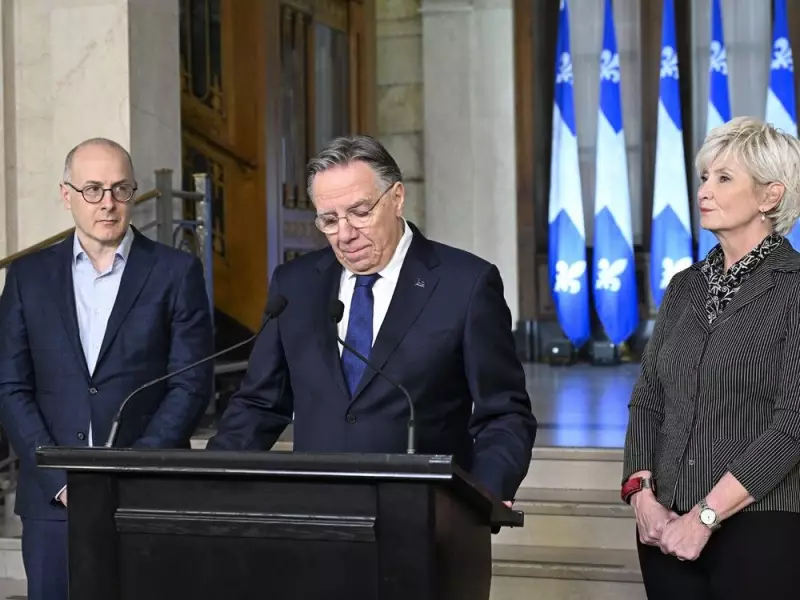
The resignation of Premier François Legault has sparked significant debate about the future of Quebec's unique political landscape, particularly regarding the viability of the so-called "third way" approach he championed. This political strategy, which sought to navigate between separatist and federalist ideologies, now faces an uncertain future without its primary architect at the helm.
The Illusion of Avoiding Constitutional Choices
André Pratte, a former chair of the Quebec Liberal Party's policy committee, argues that the "third way" represents more of a comforting fantasy than a sustainable political position. "When a referendum is held, there is no 'third way' on the ballot," Pratte emphasizes. "Like all voters, political leaders must choose: separation or federalism, Yes or No."
This perspective challenges the fundamental premise behind Legault's Coalition Avenir Québec (CAQ), founded in 2011 with the promise of moving beyond the traditional constitutional debate. The party successfully brought together sovereignists and federalists who believed Quebec should prioritize economic challenges over constitutional questions.

The Delicate Balancing Act Without Its Architect
Legault's departure creates a significant leadership vacuum within the CAQ. As the party's founder, he possessed an authority that no successor can realistically hope to match. This presents a substantial challenge for whoever assumes leadership of the party.
The political environment has also shifted dramatically since the CAQ's founding. With the Parti Québécois leading in recent polls and the possibility of a third sovereignty referendum emerging, Quebec political parties face increasing pressure to take clear positions on this deeply divisive issue.
Recent polling data reveals the complexity of the CAQ's position:
- Three-quarters of CAQ voters would vote No in a sovereignty referendum
- This constituency is gradually shrinking according to recent surveys
- Legault himself would likely vote Yes despite leading a party with predominantly federalist supporters
The Practical Limitations of the Third Way Approach
Pratte contends that the "third way" strategy has yielded disappointing results in practical terms. The CAQ government's attempts to secure additional powers or financial transfers from Ottawa have largely failed to materialize as hoped.
"To reap the full benefits of federalism, one must actually play the federalist game," Pratte argues. This requires understanding how federalism operates and building constructive relationships with the federal government and provincial partners.
Instead, Legault's government often relied on confrontation, regularly denouncing Ottawa for alleged anti-Quebec policies. While such tactics may generate short-term political gains, they ultimately prove counterproductive for achieving substantive policy objectives.
Alternative Approaches Emerging
As the CAQ leadership race unfolds, alternative political approaches are already emerging. Charles Milliard, the presumptive next leader of the Quebec Liberal Party, has promised a "nationalist and federalist" approach during his campaign launch near Trois-Rivières.
This position challenges the notion that nationalism and federalism are inherently contradictory. Quebec Liberals have historically maintained that remaining within the Canadian federation best serves Quebec's interests while advocating for provincial autonomy.
The debate over terminology reflects deeper political divisions. When Milliard used the word "nationalist," he faced accusations of being a sovereignist from political opponents. However, for Quebec Liberals, nationalism simply means that the provincial government prioritizes the interests of its population, much like other provincial governments across Canada.
Public Sentiment and Political Reality
Recent polling suggests that most Quebecers would prefer to avoid another wrenching constitutional choice. A Pallas poll conducted for Canada338 and The Walrus found that 62 percent of Quebecers oppose holding a third sovereignty referendum, with 42 percent being "very unfavourable" to the idea.

This public sentiment aligns with comedian Yvon Deschamps' famous observation that Quebecers want "an independent Quebec within a strong Canada"—essentially seeking the benefits of both autonomy and unity.
As Pratte concludes, "Quebecers want the best of both worlds—vast autonomy and Canadian unity. That is precisely what Canadian federalism makes possible." The question now is whether any political party can successfully navigate this complex terrain without resorting to the increasingly untenable "third way" approach that Legault championed.
The coming months will determine whether the CAQ can preserve its delicate balancing act or whether Quebec's political landscape will revert to more clearly defined federalist and separatist camps as constitutional questions return to the forefront of political discourse.