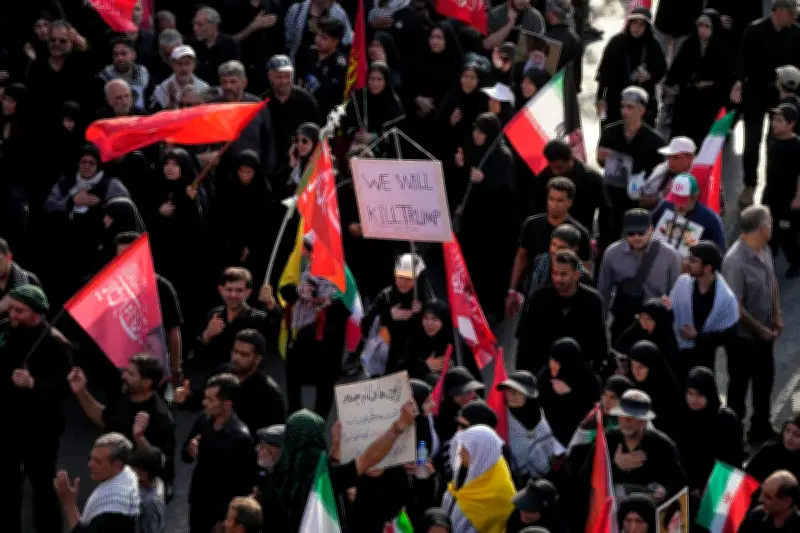
Following the death of Iran's Supreme Leader Ayatollah Ali Khamenei, mourners at his funeral carried signs reading "We Will Kill Trump," raising questions about who in the U.S. government has the authority to order retaliation if an assassination attempt succeeds.
Constitutional and Legal Framework
Under the U.S. Constitution, the President is the commander-in-chief of the armed forces and has the authority to direct military action. However, the War Powers Resolution of 1973 requires the president to notify Congress within 48 hours of committing armed forces to hostilities and limits military engagement to 60 days without congressional authorization. If the president is killed or incapacitated, the vice president would assume the presidency and, with it, the authority to order retaliation. The line of succession extends to the Speaker of the House and the president pro tempore of the Senate, then to cabinet officers in order of creation.
According to legal experts, any retaliatory strike would likely require a clear determination of responsibility and proportionality. "The president has broad authority to defend the nation, but any response must comply with international law and the Constitution," said a former White House counsel.

Current Tensions and Threats
The threat comes amid escalating U.S.-Iran tensions following the death of Ayatollah Khamenei. The AP reported that mourners in Tehran carried signs explicitly threatening former President Donald Trump, who ordered the 2020 drone strike that killed Iranian General Qasem Soleimani. Iran has vowed revenge for that killing, and the current situation has heightened fears of a direct attack on U.S. soil or against American officials.
U.S. intelligence agencies have assessed that Iran has the capability and intent to target former U.S. officials. In 2022, the Justice Department charged an Iranian military official with plotting to assassinate former National Security Advisor John Bolton. The FBI has also warned of increased threats from Iran-linked groups.
Potential Retaliation Scenarios
If an assassination occurs, the U.S. could respond with military strikes against Iranian military or nuclear facilities, cyberattacks, economic sanctions, or covert operations. The scope and scale would depend on the severity of the attack and the evidence linking Iran to the act. The U.S. has previously retaliated for Iranian attacks, such as the January 2020 drone strike that killed Soleimani in response to attacks on U.S. personnel in Iraq.
Congressional approval is not legally required for self-defense actions, but presidents often seek authorization for prolonged campaigns. The Biden administration has stated it would respond forcefully to any Iranian aggression, but the specifics remain classified.