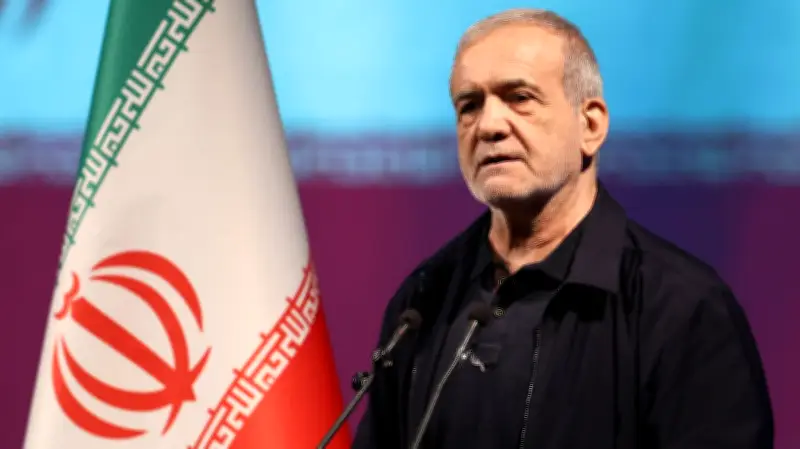
Iranian President Masoud Pezeshkian arrived in Islamabad on Tuesday for talks with Pakistani officials who have been mediating negotiations between Tehran and Washington aimed at permanently ending the war in the Middle East. The visit comes as technical teams work out details of a potential deal, following high-level negotiations in Switzerland on Monday led by U.S. Vice President JD Vance and Iran's parliamentary speaker, Mohammad Bagher Qalibaf.
Security Tight in Islamabad for Pezeshkian's First Visit Since War
Security was tight in the area where Pezeshkian was to meet with President Asif Ali Zardari and Prime Minister Shehbaz Sharif. It is Pezeshkian's first visit since the conflict started with the U.S. and Israeli attack on Iran on February 28. Pezeshkian and Sharif were scheduled to hold a joint news conference after their discussions.
Discrepancies Emerge Over IAEA Inspections and Unfrozen Funds
In Tehran, Foreign Ministry spokesperson Esmail Baghaei told reporters that no visits have been scheduled for the International Atomic Energy Agency (IAEA) to inspect Iranian nuclear sites bombed by the United States last year. This contradicts Vance's earlier statement that negotiations in Switzerland secured an agreement for IAEA inspections. The IAEA has been active in Iran since Israel's 12-day war against Iran in 2025 but has not been granted access to the bombed enrichment sites.

Regarding unfrozen funds, Vance said that if Iranian financial assets become accessible as sanctions are lifted, they would be used to buy American-grown food, with U.S. and Qatari approval. However, Baghaei stated that Tehran's import decisions would be based on “prices and quality,” questioning the logic of enriching American farmers through war. Iran's ambassador in Geneva, Ali Bahreini, added, “Iran is the only country who decides what to do with those assets.”
Technical Talks Create Negotiation Groups and De-Confliction Cell
Iran suggested that ongoing technical talks in Switzerland have led to the creation of specific negotiation groups focused on sanctions relief, nuclear issues, reconstruction, and monitoring, according to state-run IRNA news agency. The report quoted Deputy Foreign Minister Kazem Gharibabadi, who said a contact mechanism was formed for ships moving through the Strait of Hormuz and for the fighting in Lebanon between Israel and Hezbollah. The initial talks also agreed to create a “de-confliction cell” to address the Lebanon conflict.
Mediators Pakistan and Qatar said the cell would include the Lebanese government and ensure adherence to the termination of military operations in Lebanon. However, Israeli Prime Minister Benjamin Netanyahu raised new questions, stating his military retains “full freedom of action to thwart any direct or emerging threat.” Neither Israel nor Hezbollah are signatories to the U.S.-Iran deal. U.S. President Donald Trump said the situation would “get solved,” adding, “I'm a problem solver, I get problems solved real fast, including with Bibi.”
Ceasefire Holds Amid Ongoing Talks
The renewed ceasefire in Lebanon, brokered on Saturday, appeared to be holding with no new Israeli or Hezbollah strikes reported overnight. Lebanon and Israel planned another round of direct talks in Washington on Tuesday, expected to focus on developing a plan for an Israeli withdrawal. Pezeshkian cautioned that “the effectiveness of the talks depends on full commitment to the agreed obligations and their precise implementation,” and that “statements outside the agreed text do not help advance the negotiations.”