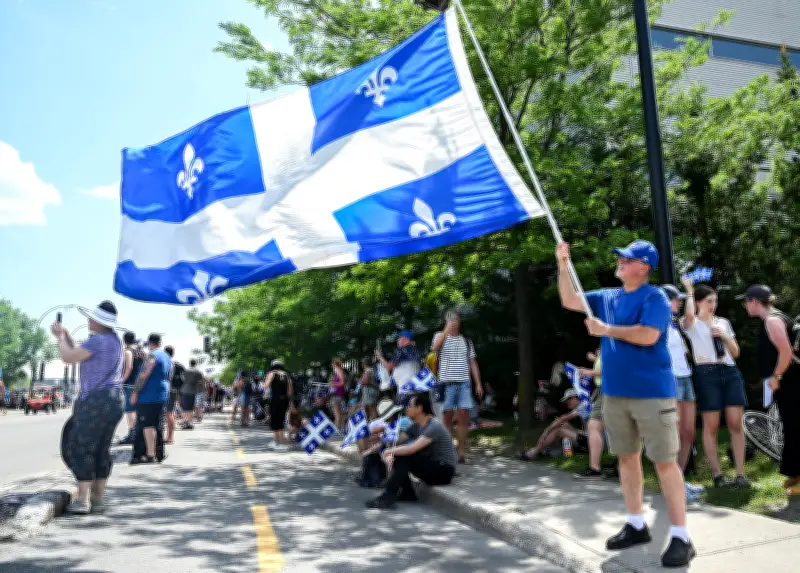
An independent Quebec would create its own armed forces and seek to join the NATO military alliance, the leader of the Parti Québécois declared Tuesday. Speaking at a Saint-Jean-Baptiste Day event in Montreal, PQ leader Paul St-Pierre Plamondon outlined his vision for a sovereign Quebec with a full-fledged military and international security commitments.
PQ proposes sovereign Quebec with military capacity
St-Pierre Plamondon said that an independent Quebec would field an army of approximately 5,000 active personnel, supported by a reserve force. The proposed military would be tasked with defending Quebec's territory and contributing to international peacekeeping missions. The PQ leader emphasized that joining NATO would be a priority, arguing that membership would ensure Quebec's security and integration into Western defense structures.
“A sovereign Quebec will not be a defenceless state,” St-Pierre Plamondon told supporters. “We will have a modern, professional army and we will take our place within NATO, just like other small nations.” He cited examples such as Denmark, Norway, and Belgium as models for a small but capable military force.

Details of the proposed Quebec army
Under the PQ plan, the Quebec army would be structured around light infantry battalions, a naval component for coastal patrol, and a cyber-defense unit. The annual budget for the military would be set at around 2% of Quebec's GDP, in line with NATO spending targets. St-Pierre Plamondon estimated the initial cost at $10 billion per year, funded by redirecting Quebec's current contributions to the Canadian Armed Forces and federal transfers.
“Quebecers already pay billions into Canada's military,” he said. “An independent Quebec would use that money to build its own forces, tailored to our needs.” The PQ leader also pledged that Quebec would maintain its participation in NORAD, the North American Aerospace Defense Command, through a bilateral agreement with the United States.
Reactions and criticism
The proposal drew immediate criticism from federalist politicians. Quebec Liberal Party leader Dominique Anglade dismissed the plan as unrealistic and costly. “The PQ is selling a fantasy,” Anglade said. “Quebecers don't want to spend billions on an army when we have pressing needs in health and education.”
Political analyst Jean-Pierre Kingsley noted that the PQ's military proposal is a significant shift from past sovereignty platforms, which often downplayed defense issues. “This is an attempt to show that an independent Quebec can be a credible player on the world stage,” Kingsley said. “But it also raises questions about how Quebec would manage the transition from Canadian forces.”
Historical context and public opinion
The PQ's sovereignty platform has traditionally focused on cultural and economic autonomy, with defense receiving little attention. The 1995 Quebec referendum on independence did not include detailed military plans. Recent polls suggest that support for independence hovers around 35%, with many Quebecers prioritizing economic concerns over constitutional change.
St-Pierre Plamondon acknowledged the challenges but insisted that sovereignty is achievable. “We are not a colony. We have the right to decide our own future, including our security,” he said. The PQ plans to release a full white paper on defense and foreign policy later this year, ahead of the next provincial election.