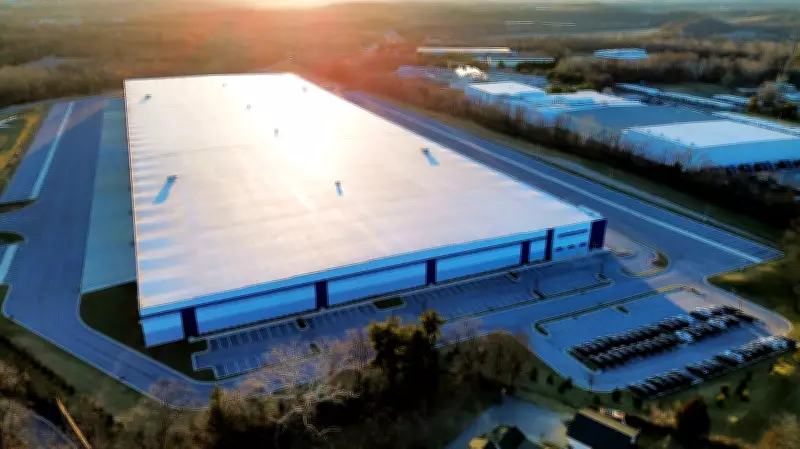
HAGERSTOWN, Md. — In January, the Department of Homeland Security purchased an 825,620-square-foot vacant warehouse a few miles outside this small Western Maryland city, with plans to transform it into a processing facility for immigrant detainees. As news spread, stunned residents sought ways to halt the Trump administration's initiative, many turning to Patrick Dattilio. Dattilio had recently launched a Signal group for locals inspired by resistance movements in Minnesota, aiming to combat the president's deportation campaign. Initially, the group, Hagerstown Rapid Response, gained only a few new members every couple of days. "You could maybe wave it away and say it wasn't here for a while," Dattilio, 38, said of the immigration crackdown. "But the warehouse changed everything." Suddenly, Dattilio struggled to keep up with membership requests. Working remotely as a software developer, he created a bot to screen prospective members. Membership quickly swelled to 100, then 500, as everyone sought ways to contribute.
Volunteers researched city and county codes, obtained water and sewer documents, and filed public record requests. An Uber driver monitored routes near the warehouse, while two drone operators conducted surveillance from a distance. In a city where protests were once limited to the downtown abortion clinic, warehouse opponents now descended on county board meetings with Rage Against the Machine blaring outside.
The Western Maryland warehouse is part of a broader Trump administration plan to convert industrial spaces nationwide into detention centers. These purchases have drawn bipartisan pushback, with residents concerned about environmental, infrastructure, and tax base impacts. However, nowhere has resistance been as fierce and organized as in Hagerstown and surrounding Washington County. The most energized opponents lack activism or political backgrounds, driven instead by a shared dread of the nation's direction and their community's role in the administration's plans.

Dattilio grew up in Hagerstown, earned a computer science degree from the University of Maryland, and returned to marry his high school sweetheart. He has four children aged 4 to 10, and his family has lived in the area for 120 years. He cannot shake the fear of Hagerstown becoming synonymous with "concentration camp." "Maybe it's 10 years, maybe it's 20 years, but if I'm still here, my kids are going to ask me what I did. And I don't know how I could look at them and say I did nothing," he said. "So that's why I started a Signal group. And because I'm impatient."
Marylanders are fighting the detention center on legal and political fronts. In February, the state's Democratic attorney general sued to block the conversion, arguing that Trump officials failed to conduct necessary environmental analyses. A federal judge in Baltimore issued an injunction in April, pausing most work while the lawsuit proceeds. Meanwhile, opponents see a rare opportunity to reshape local politics in a predominantly red area. The Washington County Board of Commissioners, all Republicans, have said little publicly but passed a resolution in February pledging support for DHS and ICE. They also enforced rules limiting public comments at meetings, angering residents across the political spectrum.
Eight Democratic candidates have declared runs for the board this year, compared to just two four years ago. They hope to use local government levers, such as the county sewer authority, to hinder Trump officials. If they can stall beyond Trump's presidency, the project might be scrapped. Dattilio, a self-described "Star Wars" nerd, views the battle as a "rebel alliance." "It starts coming down to red tape," he said. "It's just sand in the gears... There's opportunities to just slow this to an absolute crawl, to make it impossible to justify the cost of the fight. We did it with England once. We can do it again."
The western Maryland warehouse is one of 11 DHS has acquired nationwide for about $1 billion. Several purchases were scuttled due to local pushback, but Washington County residents couldn't stop the sale because Trump officials used a government procurement process designed for military emergencies, sidestepping normal procedures. The administration bought the Hagerstown warehouse for $102 million and awarded hundreds of millions in related contracts before public awareness.

Among the surprised residents were Chuck and Mary Brown, who live across the street and now plan to sell their home. They worry about anti-ICE protests and a lack of transparency. "A little bit of transparency would've been good," Chuck said. The warehouse, built five years ago during the pandemic-era logistics boom, sits near interstate highways 90 minutes from Baltimore and Washington, D.C., a prime spot for a deportation system described by former ICE Director Todd Lyons as Amazon Prime "but with human beings."
Sean Connell, 42, a forklift driver at a food distribution center, helps lead Hagerstown Rapid Response's mutual aid committee. He was not politically active until last year, when the president's agenda prompted him to join a local Indivisible branch. He now works to prepare a food pantry for detainees who may be released. His biggest concern is the warehouse empowering an agency deporting some 30,000 people monthly. However, he believes highlighting community concerns, such as the warehouse's inadequate plumbing—just four toilets—and its potential strain on water and sewer resources, is key. The facility would hold 500 to 1,500 detainees and sits near the Potomac River. "The people who find this morally repugnant are going to find it morally repugnant," Connell said. "I think a lot of people don't want it for the economic and environmental impacts."
DHS has acquired some sites at high prices. In Socorro, Texas, the agency paid $122 million for parcels assessed at $27 million. In Salt Lake City, a broker described the $174-per-square-foot paid for a vacant warehouse as "unheard of." Michael Wriston, an independent journalist from Washington County, views the warehouse plan as a bailout for overextended developers. He tracks DHS procurement for Project Salt Box, which created an ICE warehouse-tracking tool. Readers from across the ideological spectrum have offered help, including a floodplain risk expert who provided pro bono flood analyses. "It transcends political beliefs," Wriston said. "We've seen fierce resistance in deep-red states like Oklahoma and Mississippi."
Undocumented immigrants detained in Maryland are currently sent out of state due to the 2021 Dignity Not Detention Act, which prohibits local jails from contracting with ICE. This law, aimed at limiting ICE's reach, has resulted in detainees being sent far from families. Adam Crandell, a Baltimore immigration attorney, said clients have been sent to Louisiana, Georgia, Florida, Texas, Arizona, and New Mexico. In one case, legal staff had to fly to Kansas and drive to a remote Oklahoma jail. "It's hard to come out as an advocate and be in favor of opening a detention facility in Hagerstown," Crandell said. "But from the standpoint of representing people and recognizing the inevitability of some of what's happening, I'm also not out there protesting against it."
Warehouse opponents argue that keeping detainees closer to home is outweighed by increased detention capacity. As Dattilio put it, "The more warehouses we get shut down, the less people they can hold." They also cite poor conditions at existing ICE facilities, including malnutrition, medical neglect, and suicide attempts. A study found a median of 68 emergencies per center per year. Detainees describe overcrowded cells and overflowing toilets. "What we've seen over the last 20 years is that ICE detention has expanded... and the conditions never get better," said Setareh Ghandehari of Detention Watch Network.
Jennifer Janus, a Washington County pediatrician, warned that communicable diseases like flu, hepatitis A, and measles could spread from the detention center, straining local hospital resources. She outlined these concerns in an open letter signed by over 60 local doctors and nurses. "A lot of them think of it as a problem that's 10 miles away," Janus said. "It's a much more complicated issue than that." Her public stance has taken her out of her comfort zone, but she sees the implications as "seismic." "The silver lining has been finding out that there are so many other people who are on the same page as you," she said.
Colin Kelly, 29, a drone operator for Hagerstown Rapid Response, has captured footage showing DHS bringing in restroom trailers and water tanks. He said he has never seen the county so politically charged, aside from a pro-Trump trucker convoy. "I'm not going to tell you where I sit, but I don't park anywhere near there," he said of filming the warehouse. "I don't even drive past it, so they're not looking at my blue hybrid that screams 'Democrat.' Because they are watching."
Washington County voted for Trump by a 23-point margin in 2024, with 44,000 registered Republicans versus 31,000 Democrats. Yet the immigration crackdown has drawn progressives out of hiding. Laura Spivak, a recent transplant from Frederick County, said the warehouse makes the issue personal. "It just hits differently when it's right there and you see ICE agents getting a Slurpee at your 7-Eleven," she said. Spivak helped organize a satellite No Kings protest in Clear Spring, drawing 23 people, including members of "deep-rooted families." "There's probably never been anything like that here," she said.
The all-GOP board of commissioners has inadvertently boosted opposition. Last year, they tightened restrictions on comments and signs at public meetings after a First Amendment activist mooned them. Opponents believe the rules are used to shut down dissent, a charge the county denies. In March, Taj Smith, head of the local NAACP chapter, was removed from a meeting for arguing the ICE warehouse could sap emergency services. The board president called her remarks "irrelevant." Outside, a sheriff's deputy gave her a trespassing notice. In April, the board approved $118,000 in riot gear, which opponents see as acknowledging potential civil unrest.
Residents suspect board members have supported DHS's project more than they admit. Commissioner Derek Harvey, who resigned in February, served as Trump's top Middle East adviser and contributed to Project 2025. A public records request revealed that after the sale, the county administrator emailed the White House inviting a tour. The county spokesperson said commissioners did not know about DHS's plans before the purchase and declined further comment.
For Amber Dwyer, who grew up two miles from the warehouse and now raises a young daughter there, the warehouse has brought a sense of democratic collapse. She said it has "completely changed the political dynamic," turning "neighbors into enemies." She was told to sit down or leave a board meeting when speaking against the detention center. "I hate that it's happening everywhere," Dwyer said. "But when it's literally your hometown... I can't stop it from coming everywhere right now, but I can stop it from coming here."
A Democratic county board could create problems for the Trump administration. While Hagerstown provides water, the county controls the sewer system that would need expansion for ICE. All five board seats are up for election this fall. Although Democrats are outnumbered, nearly one in four voters is unaffiliated. Dave Williams, one of two Democrats who ran in 2022, now faces seven other candidates. "The climate has changed," Williams said. "People are fed up... They're standing up and speaking out for the first time in a long time."
Trump's immigration crackdown has also shaken internal Democratic politics. Rep. April McClain Delaney, a moderate Democrat, voted for the Laken Riley Act but has since disavowed the vote and introduced a bill to block the Hagerstown warehouse. The recent shake-up in DHS leadership could affect the project. Former Homeland Security Secretary Kristi Noem was ousted in March, and her replacement, Markwayne Mullin, has paused new warehouse acquisitions. However, Stephen Miller remains in the White House. A DHS spokesperson said new leadership is "reviewing agency policies and proposals."
So far, opponents are winning the legal battle. At an April hearing, Justice Department lawyers argued the facility was essential for immigration enforcement but struggled to answer basic questions about wastewater. "How can you say with a straight face that four toilets is the same as you would have with 542 people?" the judge asked. He issued a temporary injunction, allowing only a fence and basic repairs. But opponents like Dattilio assume courts will eventually allow the conversion. His group has raised money, sent mailers, divided the county into 24 districts with "ICE watch" leads, and shared their playbook with other communities. Dattilio noted little activity at the warehouse recently, with only a handful of DHS personnel. "For the most part, it's been quiet," he said. "I'm guessing it's going to stay quiet. But we're going to keep our eyes on it, just in case."