Body Language Experts Decode Hillary Clinton's Deposition Nonverbal Communication
On Monday, the full videos of closed-door depositions featuring former President Bill Clinton and former Secretary of State Hillary Clinton were released to the public. These recordings provide Americans with deeper insight into the conversations and lines of questioning from the late-February meetings. Several viral exchanges have already emerged from Hillary Clinton's deposition, including heated interactions with Representative Lauren Boebert regarding leaked photos and discussions about the "Pizzagate" conspiracy theory.
With these visuals now accessible on YouTube, albeit with watermarks, HuffPost consulted body language experts to examine notable exchanges and interpret the major nonverbal takeaways from Clinton's deposition.
Discipline and Control: The Clinton Baseline
Beth Dawson, a communication, body language, and behavior analyst, observes that Clinton demonstrates remarkable discipline as a speaker in these contexts, making her somewhat more challenging to read than her contemporaries. "Hillary Clinton is someone I often use in class to show students what restraint and control look like," Dawson told HuffPost. "Her baseline exhibits high muscular control, with maintained facial expressions, minimal fidgeting, steady posture, and measured blinking. This suggests deliberate self-regulation rather than spontaneous reactivity."

Dawson emphasizes that stillness is one of Clinton's defining features, with movements often highly controlled. "Many politicians over-gesture under stress, but Clinton often does the opposite. She reduces movement, projecting composure and authority. She is harder to read than many other politicians because she is disciplined," Dawson explained. "Highly media-trained figures like her develop controlled affect, minimal emotional leakage, consistent vocal pacing, and rehearsed posture patterns."
This control extends to emotional displays, which remain contained even under pressure. "Her emotional displays are usually very contained. Even when challenged, she often smiles briefly in response to hostile framing, tightens her lips slightly instead of showing irritation, and maintains steady eye contact while speaking," Dawson added. "That micro-smile under pressure can signal dominance, convey incredulity, or act as a self-soothing mechanism. Compared to more reactive politicians, she presents fewer obvious emotional spikes."
The Gender Dynamics of Emotional Expression
Patti Wood, a body language and nonverbal communication expert and author of "SNAP: Making the Most of First Impressions, Body Language, and Charisma," also noted Clinton's control, highlighting the tightrope women of Clinton's generation often walk regarding emotional expression, particularly anger. "She typically can't go all the way to rage and anger or yell and scream like men can get away with," Wood explained. "So what's always been difficult is that her gender is keeping her from doing something that a man in this particular situation could do: scream and yell. And she can't do that. And bizarrely, it makes her look weirder."
Dawson identifies "micro-shifts"—small tells that aren't quite emotional leakage but offer insight into Clinton's true feelings. "You might notice a slight tightening of the jaw when she is interrupted, subtle head tilts when challenging the premise of a question, controlled inhalations before responding to adversarial points, or a brief downward gaze before she reframes her answer," Dawson said. "These are subtle regulatory behaviors rather than overt emotional expressions."
Additionally, power dynamics are clearly communicated. "She frequently shifts into what could be called 'professor mode,' with her chin slightly down, eyes looking up through the brow, and a slower, deliberate cadence," Dawson adds. "That shift subtly reframes the power dynamic, moving her from the position of defendant to explainer."

Notable Moments: Boebert Leaks and Pizzagate Questions
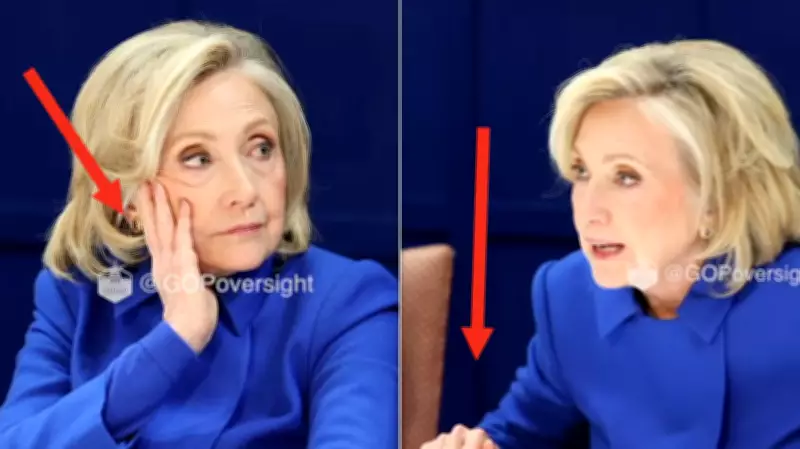
Early in the deposition, when Clinton learned about photos leaked via Boebert to conservative commentator Benny Johnson, experts observed distinct body language cues. "When she first hears about the leaked photos, she turns her head and displays a cluster of movements: a furrowed brow, hand on her chin, wide eyes, and a slight lift of the mouth corners," Dawson noted. "This is not a smile. It reflects cognitive appraisal—she is thinking through the situation and showing restrained incredulity. There is also a hint of resignation."
Dawson also highlighted a moment when Clinton sat up straighter, with hands behind the table and her front teeth lightly pressed into her lip. "Sitting up straight signals alertness or readiness and a move into a more formal posture. Hiding her hands indicates increased self-regulation. Pressing her teeth into her lip is a holding gesture, showing restraint and careful control," Dawson explained. "Taken together, this cluster reads as heightened awareness followed by deliberate containment."
Wood noted the timing of this leak, suggesting it was designed to unsettle Clinton. "When you're reading, doing a nonverbal read, context is everything. And some people from the outside might think that 'oh, putting these photos on social media is not a big deal.' But I believe it was a dramatic choice," Wood said, adding that she believes it was done to "trigger" and "create [Clinton's] dramatic response."
Wood also commented on Clinton's posture with her head resting on one hand, interpreting it as a self-comforting gesture and a classic sign of boredom. "It can also say: 'I am above this. I am so bored. I should not have to be here.'"
Later, during an outburst where Clinton stood up from the table, stating she could be held in contempt until the "cows come home," Dawson noted it remained controlled. "However, the first outburst is controlled. She declares she is done, emphasizing her words with hand movements and head nods. She is clearly signaling that she means business," Dawson said. "Her vocal tone rises and is less composed, and there is a higher pitch. The voice is actually harder to control than body movements and can reveal genuine feeling."
Exasperation Over Pizzagate Conspiracy Theory
When Boebert brought up the "Pizzagate" conspiracy theory, Clinton's exasperation became evident. "She's looking at Boebert like she's the stupidest person in the world. There's a glare, this tilted head, she's looking at her and it's like 'I cannot,'" Wood said. "The mouth tight, tightly shut lips. She's looking at her as if she's stupid. And I think that's interesting because she is revealing how she feels about Boebert in that particular situation."
Wood observed Clinton shaking her head left and right, indicating disbelief. "It would be closed body language. It would be totally different emotionally. Instead, it's 'You're stupid. This is ridiculous.'"
Dawson agreed, noting that in the initial 30 seconds, Clinton maintained her composed baseline but showed processing through long blinks and a half-frozen smile conveying incredulity. "When questioned further about Pizzagate, we see a genuine smile and her speech is precise and authoritative with a low vocal tone as she makes her point," she said. "Throughout the questioning, she sighs and exhibits authentic exasperation through breathing, blinking, and smiling clusters, all signaling how ridiculous she finds the questions."
Dawson concluded that this offers a textbook example of Clinton's approach in high-pressure situations. "Her body language, micro-shifts, and controlled responses reveal a practiced, highly disciplined approach to communicating under scrutiny while maintaining authority and composure," Dawson said. "But we can see that she can lose that composure and react more emotionally when she feels something is 'ridiculous.' Another politician might find questions, such as the Pizzagate questions, amusing or they might welcome the distraction. She doesn't. She is exasperated and she shows it."