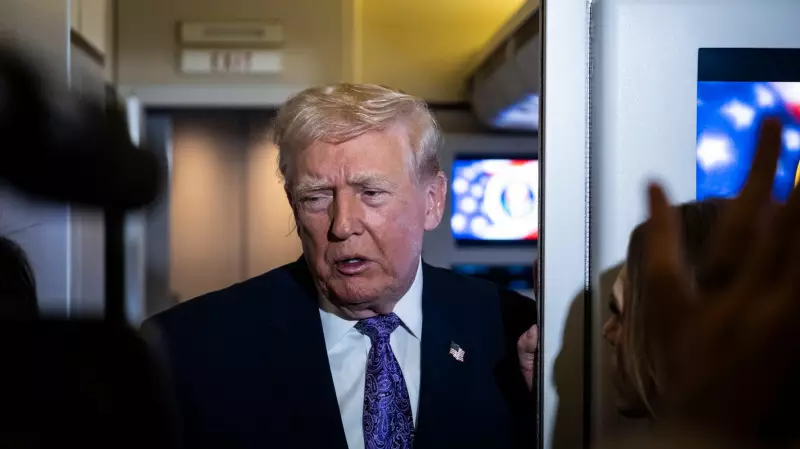
In a recent exchange aboard Air Force One, former President Donald Trump once again engaged in a contentious back-and-forth with the press, this time deflecting questions about the results of an MRI he underwent in October, which he described as "absolutely perfect." The interaction occurred on Sunday as he traveled between Florida and Washington.
A Deflective Exchange on Presidential Health
When asked about calls from Minnesota's Democratic Governor, Tim Walz, to release his medical scan results, Trump dismissed the premise. He claimed to have "no idea" what the MRI was intended to assess, despite its common use for specific diagnostic purposes. He pointedly added, "It wasn't the brain because I took a cognitive test and I aced it," turning the inquiry into a challenge of the reporters' own intelligence.
To understand the layers of this interaction, HuffPost consulted experts specializing in verbal and nonverbal communication. Their analysis suggests Trump's performance blended genuine emotion with calculated strategy.

Playful Mockery and Leaking Irritation
Communication and behavior analyst Beth Dawson observed a mix of "playfulness" and clear "irritation." She noted that Trump's playfulness was rooted in mockery, as he chided journalists with remarks like "you're failing" and "you wouldn't pass a cognitive test." Genuine enjoyment was visible in the crinkles around his eyes, yet his tone also carried flashes of defensiveness.
"His laughter is real; his irritation is real. But he deploys both deliberately," Dawson explained. She added that he uses humor to belittle serious questions and project an image of being unbothered, even on a topic like a world leader's health.
Body language expert Traci Brown emphasized that Trump's own words invited more scrutiny. "He says, 'I have no idea what they looked at.' Everyone has an idea — at least a general one — of what they're getting an MRI for," Brown stated, comparing the evasion to tactics seen in investigations.
Nonverbal Cues Tell a Deeper Story
Despite the cool facade, Dawson identified subtle "cracks" revealing Trump's annoyance. Clusters of rapid blinking at certain points indicated the questions had "struck a nerve," serving as quick flashes of emotional leakage. Another telling moment was a slight frown combined with an open mouth, an expression of "disbelief and annoyance" that briefly surfaced before being folded back into humor.
A sharp, jerky head gesture to the left when he mentioned being impeached signaled an internal spike of irritation or tension. Furthermore, Trump's characteristic "chin jut" — pushing his chin forward — was noted as a physical signal of superiority, challenging the reporters and framing their questions as beneath him.
Dawson summarized that these signs show "he is working hard to keep the narrative where he wants it," using his entire body to reshape the interaction's tone into a blend of mockery, irritation, and dominance.
Amusement as a Tactical Weapon
The analysis highlighted that Trump's genuine-looking smile, with lip corners turned up and wrinkles at the outer eyes, frequently appears when he feels socially powerful. In this context, however, amusement was a tactic. "Rather than treat the MRI question as serious or legitimate, he frames it as something slightly ridiculous, something he can play with," Dawson said. The immediate shift to attacking the journalists' intelligence, Brown noted, is also a familiar strategy when he doesn't want to address the substance of a query.
Ultimately, the experts concluded that the exchange became less about providing health reassurance and more about a performance aimed at establishing dominance. "He may not feel threatened by the question," Dawson concluded, "but he does feel the need to dominate it."