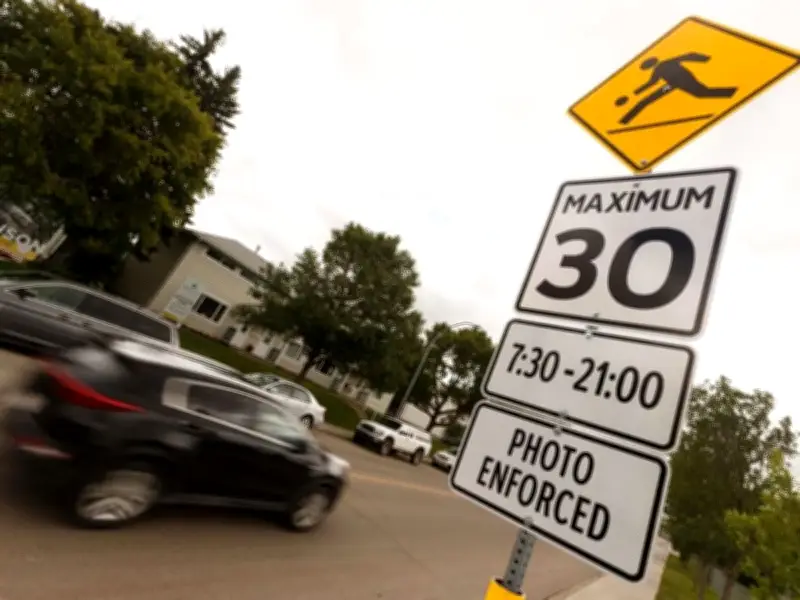
Automated traffic enforcement (ATE), commonly known as photo radar, has been used in Alberta since 1987. Despite its aggressive deployment in Edmonton, the city recorded 31 traffic fatalities in 2009, 29 in 2012, 31 in 2015, and 29 in 2025, according to data cited in a letter to the editor by Mitch Lavoie.
Post-Pandemic Decline Not Due to ATE
While the number of traffic fatalities in Edmonton dropped after the pandemic, Lavoie argues this decrease cannot be attributed to ATE but rather to altered societal factors. He also contends that the recent increase in fatalities is not entirely the result of discontinuing ATE, as other factors are at play.
Population Growth and Vehicle Numbers
Edmonton's population grew from 1 million in 2020 to 1.2 million in 2025, while the Edmonton region increased from 1.4 million to 1.69 million over the same period. More people naturally mean more vehicles on the road, contributing to collision risks.

Intersection Dangers and Distracted Driving
Records indicate that 67 per cent of traffic fatalities occurred at intersections. A 2018 Edmonton Journal article identified 659 dangerous crosswalks in Edmonton, many resulting in multiple pedestrian injuries. At that time, city councillor Andrew Knack described the number as “alarming.” Lavoie questions how many of those dangerous crosswalks have since been remediated.
Edmonton also suffers from an epidemic of distracted driving, which has been confirmed as extremely dangerous behaviour. Lavoie suggests that rigid enforcement of distracted driving laws would almost certainly increase traffic safety. While speed is an issue, he emphasizes it is far from the only one.
Letter on Driver's Licence Changes
In a separate letter, Inez Dyer criticizes the Alberta government's decision to require additional personal information on driver's licences, including Alberta Health numbers and proof of citizenship. Dyer, a retired banker, cites concerns about identity theft, noting that branches lost thousands of dollars annually due to identity fraud. She questions who will compensate those whose identity may be stolen due to having so much personal information on a single document, calling it an overreach by a government seeking excessive control.