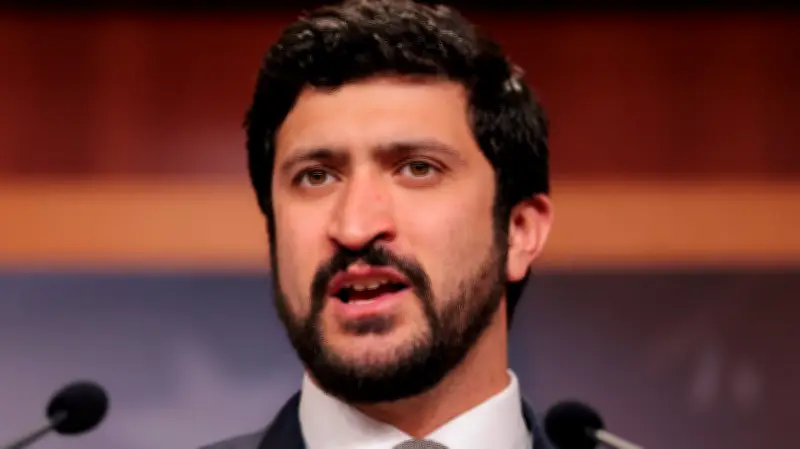
House Democrats plan to introduce a bill this week that would double the premium employees receive for working overtime, part of a broader “affordability” agenda designed to help the party retake Congress in this fall’s midterm elections.
Rep. Greg Casar (D-Texas), chair of the Congressional Progressive Caucus, told HuffPost the legislation would boost paychecks for many workers while giving others more time with their families. He sees it as a necessary update to an outdated law — as well as good politics.
“It’s time for Democrats to think bigger about pro-worker policies,” Casar said. “Whether workers are diehard Democrats or Trump voters, they feel like both political parties have failed them on making life more affordable.”

“This is the kind of simple and clear idea that workers across the country are asking us for,” he added. “It’s how Democrats can regain the trust [of] working people.”
The Fair Labor Standards Act of 1938 requires employers to pay eligible workers time-and-a-half for the hours they work above 40 in a week. The new bill, which Casar is sponsoring alongside Rep. Pramila Jayapal (D-Wash.), would increase that premium so that employees earn twice their pay on overtime hours.
The proposal is something of a response to President Donald Trump’s “no tax on overtime” policy that became part of his Big Beautiful Bill, passed by Republicans last year. For many filers, the Trump tax break was not as juicy as it seemed: Only the premium portion, or the “half” of “time and a half,” goes untaxed, with a deduction capped at $12,500. But it is the sort of policy that resonates with voters who feel overworked and underpaid — so much so that many Democrats endorsed the idea despite criticism of it from progressive economists.
Casar argued that doubling the overtime premium would be a more effective change to the law. “While giving working people that work overtime or work for tips a tax break is a fine idea, we could do so much more,” he said. “We can make it so that workers that work overtime make double time instead of just getting a small tax break that a lot of workers are seeing isn’t as much as they had hoped for.”
Democrats see affordability as a winning message as Trump’s war with Iran pushes up oil prices that filter through the consumer economy. Along with the overtime proposal, the party is pushing a government-run prescription drug program, a cap on childcare costs as a share of a worker’s income, a paid vacation mandate and a ban on surveillance pricing in grocery stores, among other ideas.
There is no in-depth analysis evaluating the economic impacts of increasing the overtime premium. But Samantha Sanders, director of government affairs at the Economic Policy Institute, said the progressive think tank has taken a look at the idea and generally likes it. “We think it’s a pretty solid proposal and relatively simple,” she said.
The overtime premium is meant to reward workers for their extra time — and also discourage employers from piling too much on them. It was crafted during the high unemployment of the Great Depression in the hope that companies would spread the work around and hire more, rather than foist it all on a smaller group. Sanders anticipates the Democratic proposal would amplify the incentives and effects of the existing law. Some employees who work a lot of overtime would see bigger paychecks. Others would see their overtime hours drop as employers try to avoid the stiffer premium, but they might end up with the same paycheck for slightly fewer hours.
She said around 13.4 million workers regularly work overtime and could be affected. “Overall, it would end up with workers getting more money and less overwork,” she said.
Overtime pay may be a bedrock labor protection, but a far smaller share of the workforce is eligible for it than used to be. Businesses have lobbied hard over the years to limit the number of salaried workers covered by the law, with some help from Republicans. The Trump administration abandoned a reform by President Joe Biden that would have greatly expanded the share of eligible workers by raising the so-called overtime salary threshold — the level below which most salaried workers are guaranteed overtime pay when they work long hours.

Casar said raising that threshold is an important step in strengthening the law to protect more people. But he said we should also be asking “how much does overtime pay in the first place.”
“People have just assumed that that time-and-a-half is written in stone somewhere,” he said. “If we want workers to gain more of the wealth in our society that they’re creating, we should update these laws that were passed by the great labor movements of a century ago.”