Conservative Identity Under Scrutiny Following Recent Political Events
The recent Conservative Party convention in Calgary and the official portrait unveiling for former Prime Minister Stephen Harper in Ottawa have reignited fundamental questions about the Conservative Party's purpose and direction in Canadian politics. These parallel events occurring within days of each other highlight both the party's current challenges and its historical significance.
Poilievre's Convention Triumph and Historical Context
Pierre Poilievre's successful convention appearance in Calgary marked a significant moment for the Conservative leader, coming after his disappointing federal election loss and the loss of his own parliamentary seat last April. His return to Alberta to consolidate leadership through a byelection represents a strategic regrouping effort.
Historical patterns reveal the magnitude of Poilievre's challenge. Throughout Canadian history, whenever the Liberal Party has won three consecutive elections, they have consistently won the fourth contest. This pattern has held true in five instances: 1908, 1949, 1972, 2004, and most recently in 2025. On two occasions, the Liberals extended their streak to five consecutive victories in 1953 and 1974.

Harper's Legacy and Conservative Breakthroughs
The ceremony honoring Stephen Harper's official portrait in Parliament this week coincided with the 20th anniversary of the 2006 election, where Harper achieved what only Sir Robert Borden had accomplished before him: denying the Liberals a fifth consecutive victory. This historical perspective places Harper among rare Conservative leaders who managed to interrupt Liberal dominance at critical moments.
Other Conservative leaders like John Diefenbaker and Joe Clark succeeded in preventing sixth consecutive Liberal victories, but Harper's 2006 achievement stands as particularly significant given the historical patterns of Canadian electoral politics.
Policy Influence and Political Positioning
Current dynamics suggest Conservative policies continue to influence national discourse despite electoral setbacks. Poilievre emphasized during his convention speech that Conservative positions on key issues including carbon taxes, inflation, housing, natural resources, crime, and drug policy have gained increasing acceptance.
"We won the debate in the last election on every single one of the big issues," Poilievre stated. "First the Liberals said, 'Conservatives have no policies. It's just slogans.' Then they said, 'Conservative policies are very scary.' And then they said, 'We agree with all the Conservative policies.'"
This pattern of policy adoption echoes historical precedents. Former Prime Minister Jean Chrétien, who appeared alongside Harper during this week's celebrations, famously embraced Brian Mulroney's GST and NAFTA policies during his own administration after campaigning against them. Chrétien went further by balancing the federal budget through spending cuts that were previously considered politically impossible.
Prime Minister Carney's Recognition of Harper's Legacy
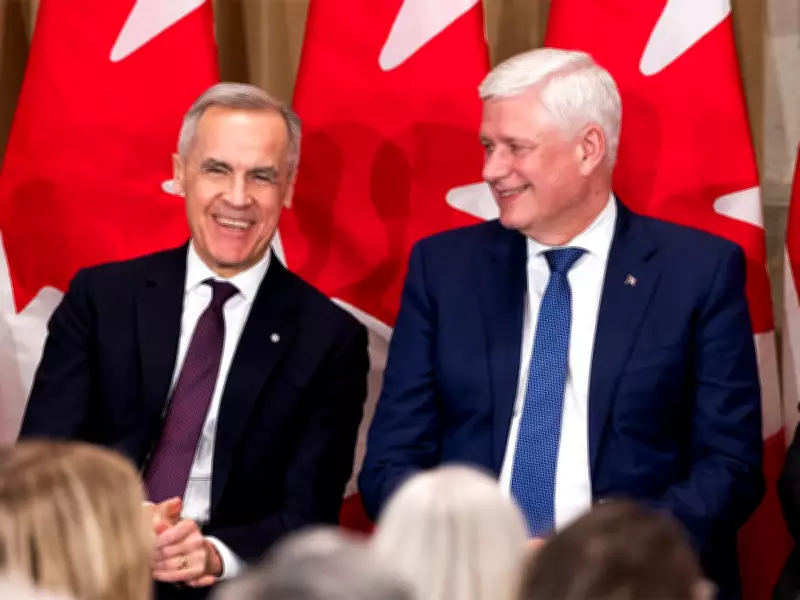
During the portrait unveiling ceremony, Prime Minister Mark Carney offered notable praise for his Conservative predecessor, specifically highlighting Harper's "sound fiscal management" during his time in office. This acknowledgment from a sitting Liberal prime minister underscores the enduring impact of Conservative policies on Canada's economic framework.
The event brought together political figures from across party lines, with Chrétien appearing alongside Harper on both Monday and Tuesday, demonstrating the ceremonial recognition that transcends partisan divisions in Canadian political tradition.
Future Prospects and Historical Patterns
Historical electoral patterns suggest Poilievre has strong prospects for eventually becoming prime minister. Should he win the next election, he would join Borden and Harper as Conservative leaders who interrupted Liberal winning streaks at critical junctures. Even if unsuccessful in the immediate contest, historical precedent suggests the Conservative leader would likely prevail in the following election, as Liberals have never achieved six consecutive victories.

Since the era of Sir John A. Macdonald, Conservatives have consistently faced challenging electoral terrain in Canada. This reality raises important questions about whether holding power matters more than influencing policy direction, particularly when opposition ideas eventually become adopted by governing parties.
The convergence of Poilievre's convention success and Harper's official recognition this week provides a moment for reflection on the Conservative Party's evolving role in Canadian politics, its policy influence across party lines, and its historical significance in shaping the nation's direction.