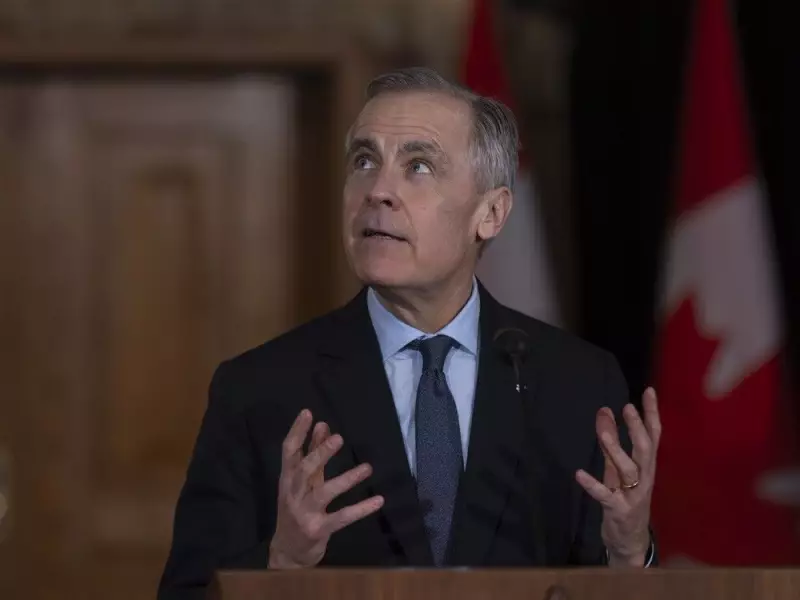
Carney's Plains of Abraham Address Stirs Controversy in Quebec
Prime Minister Mark Carney's recent speech in Quebec City, intended to foster national unity, has instead ignited a firestorm of criticism across Quebec's political spectrum. The address, delivered at the historic Citadelle overlooking the Plains of Abraham, has been widely condemned as demonstrating Ottawa's disconnect from Quebec's historical reality.
Location and Delivery Heighten Sensitivity
Carney chose to speak exclusively to media members while surrounded by his ministers at the Citadelle of Quebec, a military fortification with commanding views of the Plains of Abraham. This location holds profound historical significance for Quebecers, as it was the site of the pivotal 1759 battle during the Seven Years' War where British forces defeated French troops, leading to France's surrender of New France to Britain.
In his French-language remarks, Carney framed the Plains of Abraham as representing "the place where Canada began to make its founding choice of accommodation over assimilation, of partnership over domination, of building together over pulling apart." While acknowledging darker historical moments like the Deportation of the Acadians and the Durham Report, his overall interpretation faced immediate pushback.

Quebec Political Leaders Unite in Criticism
The reaction from Quebec's political class was swift and nearly unanimous. Parti Québécois Leader Paul St-Pierre Plamondon accused Carney of falsifying history, while Bloc Québécois Leader Yves-François Blanchet demanded an apology from the prime minister.
Quebec Immigration Minister Jean-François Roberge offered particularly sharp criticism, telling Radio-Canada: "The Battle of the Plains of Abraham are the conquest, the culmination point where the English came and defeated the French and burned villages." He accused Carney of rewriting history to suit a particular narrative.
Even Federalist Voices Express Concerns
Remarkably, criticism extended beyond sovereigntist circles to include federalist voices. Liberal Party of Quebec leadership hopeful Charles Milliard, a self-described proud federalist, suggested Carney's speech would have benefited from greater nuance.
"The survival of a francophone nation in America does not rest on a 'chosen partnership' with British administrators, but on the resilience, determination and spirit of resistance of French Canadians and Quebecers," Milliard stated. "We cannot ignore the darker parts of our history."
Academic Perspective on Historical Symbolism
Daniel Béland, director of the McGill Institute for the Study of Canada, explained why Carney's historical framing proved so problematic. "The Battle of the Plains of Abraham is a symbol of humiliation and defeat for many francophones," he noted.
Béland drew a parallel to former prime minister Justin Trudeau hypothetically giving a speech in Calgary's "Red Square"—formerly the Petro-Canada Centre, which evokes memories of his father's controversial National Energy Program—to improve relations with Alberta. The comparison underscores how historical sites can carry complex emotional weight that transcends official narratives.
Mixed Reactions Within Carney's Government
Even within Carney's own government, support for the speech appeared tepid. Heritage Minister Marc Miller stated he had not seen the address, while Quebec MP Steven Guilbeault declined to comment altogether. This lukewarm response from cabinet colleagues suggests the speech's messaging may have missed its intended mark even among federal representatives.
The controversy highlights the ongoing challenges of crafting historical narratives that resonate across Canada's diverse regions, particularly when addressing events with divergent interpretations in English and French Canada.