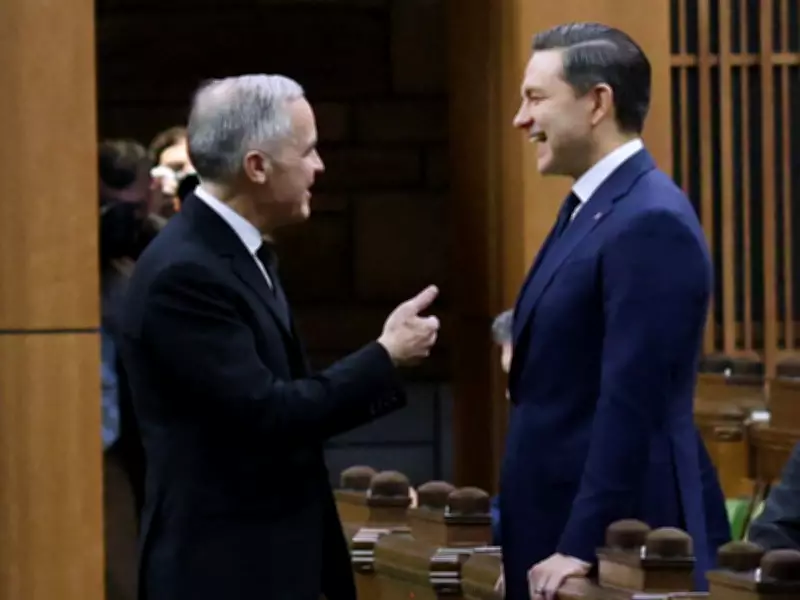
Carney's Majority Mandate Faces Significant Challenges Despite Poilievre's Setbacks
OTTAWA — As Prime Minister Mark Carney celebrates a defection-fueled majority mandate following Monday's byelection victories, political experts warn that significant challenges lie ahead for the Liberal government. Despite Conservative leader Pierre Poilievre facing mounting difficulties, analysts suggest Carney's path forward remains fraught with obstacles.
Fragile Majority and Parliamentary Dynamics
Political commentator Stephen Taylor, a partner at Shift Media, emphasized that cobbling together an extra-electoral majority has created a parliamentary environment where trust is optional and floor-crossing has become normalized. This situation, he argues, will create substantial difficulties for the Liberal caucus.
"A slim majority will be difficult for the Prime Minister to handle, and the poor vetting and tenuous loyalty suffered by Poilievre now becomes Carney's problem in a much more fragile caucus," Taylor told the Toronto Sun. "While a majority projects confidence on the surface, it's much more brittle underneath — expect Avi Lewis to enjoy wedging the Liberals in Parliament, and expect Poilievre to join in, once he's licked his wounds."

Conservative Unity Amidst Rumors
Despite persistent rumors that the five Conservative MPs who crossed the floor to join the Liberals won't be the last, the Conservative caucus publicly maintains unwavering support for Poilievre. Members of Parliament told reporters following Wednesday's caucus meeting that they remain united and strong.
The Conservative Party delegates gave Poilievre an impressive 87% approval rating at their January convention in Calgary — surpassing even Stephen Harper's 84% approval following the 2005 election loss. Additionally, last year's federal election saw the Conservatives gain 25 seats in the House of Commons, flip 17 ridings from the Liberals, and secure 41.3% of the popular vote — their strongest performance since the 1988 federal election.
Aurora—Oak Ridges—Richmond Hill MP Costas Menegakis described Wednesday's meeting as "very, very positive" and emphasized the party's focus on addressing Canadian priorities rather than floor-crossing activities.
Poilievre's Continuing Challenges
Liberal strategist Sharan Kaur, principal at Navigator, noted that Poilievre's high convention approval rating didn't translate to strong Conservative voter turnout during Monday's byelections. "He won by a pretty high number at his convention, and I think people were expecting that as he walked out of that, that momentum would carry on," she observed.
Kaur highlighted the departure of Sarnia—Lambton—Bkejwanong MP Marilyn Gladu as an alarming indicator for Poilievre's leadership. She suggested that Monday's majority outcome doesn't signal the end of Poilievre's problems, stating: "I actually think he's in a lot of trouble. I think it's in his best interest to stay quiet for a while, because now that the Liberals have their majority, they can be their own worst enemies — when you're in a position where you have what you want it's easy to mess up, and I think that's what Poilievre is going to be waiting for."
Generational Challenges for Conservatives
Alexander Brown, director of the National Citizens Coalition, identified generational challenges facing the Conservative Party. He noted that while Conservatives benefited from record voter turnout and increased support among young voters during the last election, maintaining this coalition presents significant difficulties.
"The challenges are generational — Conservatives benefited immensely from a record voter turnout, and a record turnout of young voters to their cause," Brown explained. "How do you keep them happy and in the tent when their pocketbook issues rate differently than a Liberal support base that now trends overwhelmingly 50-plus?"

Brown emphasized that moving forward requires substantive policy solutions rather than political excuses. He outlined several priorities for effective governance: "The solutions should be obvious: build pipelines; rebuild our immigration standard; send home those on expired and expiring 'temporary' status in areas we do not need; borrow from peer countries when it comes to layered, nuanced healthcare delivery; enforce, and reinforce our laws. No amount of tinkering around the margins will cut it."
Addressing Carney's majority mandate, Brown concluded: "If Carney is indeed serious about taking advantage of the next few years, he'll ditch the excuses, some of the empty Trudeau rhetoric, and actually build. With a majority mandate, mainly cobbled together with the help of a rogue's gallery of CPC backbenchers, we're far beyond time to put up or shut up."