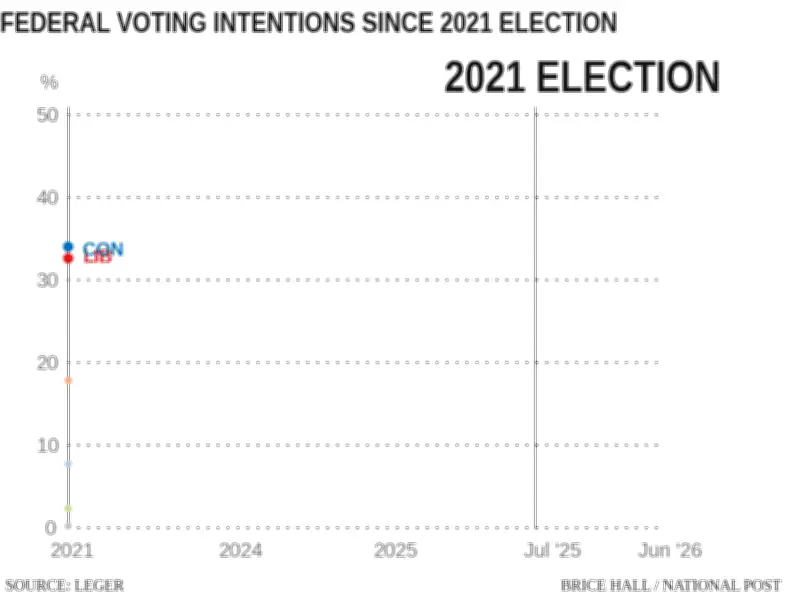
A new Postmedia-Leger poll has revealed that the Carney Liberals now enjoy the support of half of all Canadians, marking the first time a governing party has reached this milestone in popular support in more than two decades.
The poll, conducted over the past week, found that 50 per cent of decided voters would most likely support the Liberals if federal elections were held today. Prime Minister Mark Carney himself holds an approval rating of 56 per cent, according to the survey.
Conservative Support Declines
The Conservatives trail at 34 per cent, down three percentage points from April. Both the New Democrats and the Bloc Quebecois are at six per cent, unchanged from the previous month, while the Green Party sits at three per cent, up one point.

The combined support for the two major parties is nearly identical to the historically high 85.1 per cent recorded during the last federal election, when the dominant issue was Canada's response to trade and sovereignty threats from U.S. President Donald Trump.
Shift in Voter Sentiment
Over the past 16 months, there has been a notable transfer of approximately seven percentage points of Conservative support to the governing Liberals. Andrew Enns, Leger's executive vice-president, highlighted that no Canadian government has topped 50 per cent since 2003, when Prime Minister Jean Chretien decided against participating in the U.S.-led invasion of Iraq without a UN Security Council resolution.
Enns described the 50-per-cent mark as a significant psychological hurdle, representing a real majority. 'That's a big number,' he said. 'We just don't see it often in Canada.' He noted that Justin Trudeau's Liberals came close in 2016, reaching 49 per cent in the polls during their first mandate.
Regional and Demographic Strength
The poll indicates sturdy Liberal support across the country, particularly in Atlantic Canada (62 per cent), British Columbia (56 per cent), and among Canadians over 55 (59 per cent). The party is weakest in Manitoba-Saskatchewan (31 per cent) and Alberta (36 per cent), consistent with recent decades.
Support is largely consistent among men (48 per cent) and women (52 per cent), as well as among urban (52 per cent), suburban (49 per cent), and rural (45 per cent) voters.