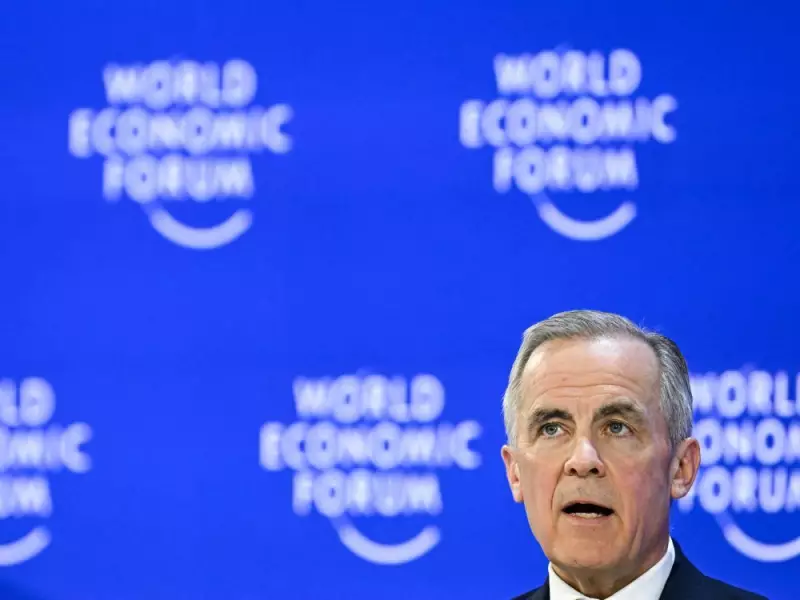
Mark Carney's Davos Address Faces Criticism Over Domestic Blind Spots
Mark Carney's recent speech at the World Economic Forum in Davos has drawn significant attention and critique from commentators like Avi Benlolo. While Carney delivered what many considered an impactful and masterful address about the changing global order, Benlolo argues the former Bank of Canada governor failed to address critical domestic issues facing Canada.
The Global Vision Versus Domestic Reality
Carney's Davos presentation served as a kind of state of the union for Canada on the international stage, outlining his vision for how the country should position itself in what he described as a new world order. His approach involves marketing Canada to new trading partners and moving beyond traditional alliances. However, this strategy has raised concerns about potentially turning away from Canada's most significant ally and trading partner—the United States.
Canada certainly deserves to carve its place in the world, as Carney emphasized, rejecting the notion that the country should simply "get along and go along" with international consensus. This echoes former Prime Minister Stephen Harper's principled foreign policy stance, particularly regarding support for Israel and combating antisemitism. Harper famously argued against the "easy thing" of going along with anti-Israel rhetoric under the guise of even-handedness.

Questionable International Partnerships
Benlolo questions whether Carney's approach means Canada should become less principled about its international partnerships for economic gain. The red carpet treatment Carney received from countries like Qatar and China raises concerns about aligning with nations that don't share Canada's democratic values or human rights standards. Both countries have problematic records in these areas, yet they feature prominently in Carney's vision for Canada's economic future.
The "rules-based order" Carney described as fading internationally appears to be deteriorating domestically as well, according to Benlolo. Canadian laws and rules seem increasingly inapplicable in certain situations, with the government apparently hoping that compliance will buy safety—an approach Carney himself criticized in his Davos remarks.
Domestic Rupture Ignored
While Carney spoke about global rupture at Davos, Benlolo points to a domestic rupture that has been developing over the past two years. Canada has witnessed extreme episodes of violence, harassment, and calls for "intifada revolution" that have created significant social fractures. The government's response—or lack thereof—to Islamist groups occupying streets with violent and hateful rhetoric while escaping legal consequences has created what Benlolo describes as a dangerous precedent.
Carney's observation that "people participate in rituals they privately know are wrong—by living a lie" applies directly to the Canadian context, according to Benlolo. Thousands of Canadians have participated in pro-Hamas marches despite the group's terrorist designation and its murder of 1,200 people on October 7. Meanwhile, the government has stood by without adequately protecting the Jewish community, seemingly validating Carney's Davos statement that "the strong can do what they can, and the weak must suffer what they must."
Erosion of Canadian Values
Canada's celebrated multicultural mosaic—once a source of national pride—has corroded significantly, according to Benlolo. Despite Carney touting Canada's virtues of pluralism and coexistence at Davos, the reality on the ground tells a different story. Seventy percent of religious-based hate crimes target the Jewish community, yet government response has been inadequate. This situation exemplifies Carney's observation that "The system's power comes not from its truth, but from everyone's willingness to perform as if it were true."
Antisemitism now emanates from power structures that permit false narratives to persist, creating what Carney might describe as "a rupture, not a transition." For over 150 years, the Jewish community has been integral to Canadian society across all professional sectors. The recent escalation of violence, harassment, and revolutionary rhetoric threatens not just social cohesion but potentially Canada's economic stability as well.

Benlolo concludes that while Carney's international analysis may be insightful, his failure to address these domestic issues represents a significant oversight. The rupture Carney identifies globally is mirrored—and perhaps even magnified—within Canada's own borders, requiring urgent attention that his Davos address conspicuously lacked.