Prime Minister Mark Carney Declares Canada's Stance on Iran Conflict
Prime Minister Mark Carney has stated that Canada will defend its allies in the ongoing conflict with Iran, while refusing to categorically rule out future military participation. During a press conference outside Australia's parliament in Canberra, Carney emphasized that the situation remains volatile and complex, with the conflict expanding to involve Gulf states.
No Absolute Exclusion of Military Role
When questioned specifically about whether Canada would maintain its current non-military stance if hostilities continue or escalate, Carney responded, "one can never categorically rule out participation." He clarified that while Canada was not informed in advance about recent U.S. and Israeli assaults on Iran, the country stands by the fundamental principle that Iran should not be allowed to develop nuclear weapons or violate international law.
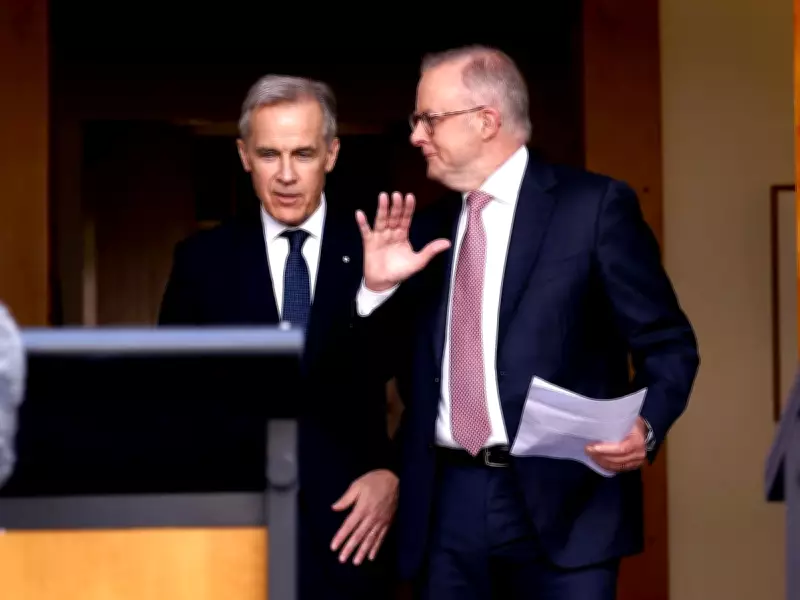
Carney appeared alongside Australian Prime Minister Anthony Albanese after addressing the Australian parliament and confirming a new critical minerals deal. Both leaders issued separate statements supporting the U.S. decision to launch attacks, citing the need to prevent Iran's nuclear ambitions.

Distinction Between Offensive and Defensive Actions
The Prime Minister drew a clear distinction between offensive military actions and defensive measures. "We will always defend Canadians," Carney stated. "We will always stand by and defend our allies when called upon." He added that Canada will defend allies "when it makes sense," suggesting a calculated approach to international military engagements.
These comments come amid reports from the Middle East that Iran fired a missile at Turkey, which was subsequently shot down by NATO forces. Under Article 5 of the NATO alliance, an attack against one member country is considered an attack against all others, potentially drawing Canada further into the conflict.
Criticism and Context of Canada's Position
Carney has faced criticism for Canada's initial position regarding the U.S. strikes against Iran. Reports of the attacks emerged as he arrived in India during a nine-day trip aimed at drumming up trade support, with subsequent stops in Australia and Japan. Critics, including at least one of his own MPs and former Liberal cabinet minister Lloyd Axworthy, have questioned the legality of offering full-throated support for the U.S. actions.
Despite this criticism, Carney and his ministers have spent recent days underscoring that tensions in the region must begin to lower. Albanese echoed this sentiment, telling reporters that de-escalation is needed in Iran's retaliation, particularly concerning the Gulf States.
Carney concluded by emphasizing the uncertainty of conflict situations: "In terms of war, there are likelihoods, there are possibilities, you have to plan for the worst, but there are no certainties in conflict." This statement reflects Canada's cautious yet prepared stance as the Middle East situation continues to evolve.