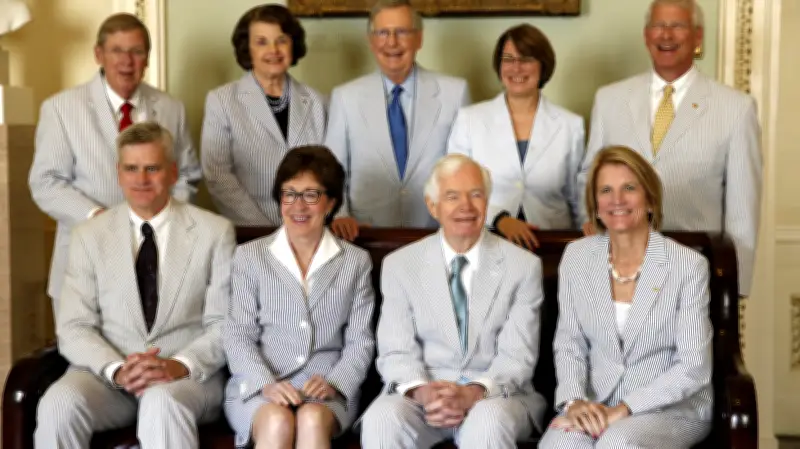
Apparently there is one thing Democrats and Republicans can agree on these days, and it is seersucker. Senator Bill Cassidy (R-La.) and Senator Raphael Warnock (D-Ga.) introduced a resolution this week to designate June 11 as National Seersucker Day and June 2026 as Seersucker Appreciation Month.
The bipartisan resolution also deems every subsequent Thursday through the last Thursday in August 2026 as Seersucker Thursday. While the move might feel out of left field in this political climate, congressional watchers know this is part of a longstanding tradition in the Senate. In fact, the same resolution was introduced in previous years as well.
Origins of Seersucker Thursday
Credit for the annual Seersucker Thursday tradition goes to former Senate Majority Leader Trent Lott (R-Miss.). According to the Senate official website, senators in the South used to wear seersucker in the early 1900s to keep cool in the summer because the fabric is very breathable. They continued to wear the fabric until air conditioning became widely available in the 1950s. Senator Lott liked wearing seersucker, and in the 1990s he introduced Seersucker Thursday, reserving it for a nice and warm day in the second or third week of June.

Women Join the Tradition
Senator Dianne Feinstein (D-Calif.) later introduced the tradition for women in 2004. I would watch the men preening in the Senate, she said, according to the Senate website, and I figured we should give them a little bit of a horse race. In June 2017, Senator Feinstein made headlines for showing up to former FBI director James Comey hearing in a seersucker suit. While some people questioned the appropriateness of the suit given the seriousness of the hearing, Feinstein look also drew praise online. She was not the only one in stripes that day.
Senator Cassidy told Roll Call that Seersucker Thursday is just plain fun and celebrates an American product invented in his home state of Louisiana. It is a lighthearted tradition and shows that the Senate is not a bunch of boring suits.
History of Seersucker Fabric
The fabric itself has an interesting backstory. The term seersucker derives from the Persian phrase shirushakar, meaning milk and sugar. The fabric signature stripes and texture result from a specific technique that involves weaving linen, cotton, silk, or synthetic fibers on twin-beam looms at different speeds. New Orleans-based haberdasher Joseph Haspel invented the seersucker suit in the early 20th century, and it quickly gained popularity among southern businessmen before spreading to Ivy League students and professionals in the Northeast.
These days, the fabric might not be everyone cup of tea, but there is no denying seersucker endures, at least in the summer heat and humidity of Washington, D.C.