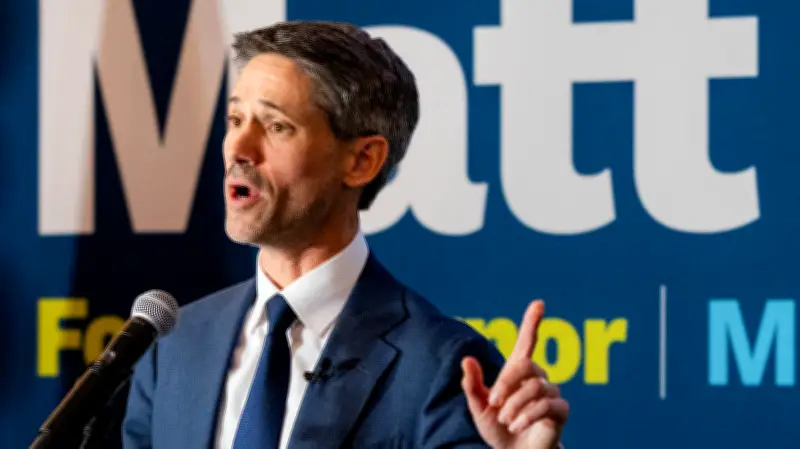
After investing heavily in several key races, Big Tech suffered a set of bruising losses in the California primaries on Tuesday. Perhaps the most high-profile was that of San Jose Mayor Matt Mahan (D), who was in a distant sixth in the governor's race, with roughly 4% of the vote, as of press time.
A vocal opponent of a proposed statewide billionaire's tax, Mahan entered the gubernatorial race in January as Silicon Valley's preferred candidate. His campaign, which embraced a moderate platform on issues like public safety and housing, wound up garnering the backing of tech leaders including Google co-founder Sergey Brin, Palantir co-founder Joe Lonsdale and Y Combinator CEO Garry Tan. Tech-backed groups, like the independent expenditure committee Back to Basics, also spent millions on ads – including a splashy Super Bowl commercial – to boost Mahan in the crowded gubernatorial primary.
Shortly after polls closed on Tuesday, Mahan, a former tech executive himself, conceded, acknowledging that his campaign didn't have a path forward.

In California's 17th House district, tech entrepreneur Ethan Agarwal also struggled to gain traction in a challenge to five-term incumbent Rep. Ro Khanna (D-Calif.). Agarwal had similarly opposed the statewide billionaire's tax and criticized Khanna's backing for a wealth tax proposal in Congress. Prominent tech figures like Coinbase CEO Brian Armstrong, DoorDash cofounder Stanley Tang and venture capitalist Ron Conway were among those who supported Agarwal's campaign. As of press time, Agarwal was in fourth place with 6% of the vote.
In Monterey Park, a first-of-its-kind ballot measure banning data centers in the southern California city also passed with overwhelming support, underscoring public concerns about the effects that such projects have on local communities and the environment.
Lorena Gonzalez Fletcher, president of the California Labor Federation, previously told The Associated Press that Mahan's backing from tech could have turned off voters, given broader backlash toward corporate power. “People do not want somebody who is a puppet of these big tech billionaires, of these AI billionaires – and that’s who he has always been,” said Gonzalez Fletcher. The California Labor Federation endorsed billionaire environmental activist Tom Steyer, former U.S. Rep. Katie Porter and former Los Angeles Mayor Antonio Villaraigosa.
The tech industry notched at least one major win on Tuesday. In the race for California's 11th congressional district, state Sen. Scott Wiener, who has received donations from tech billionaires like OpenAI CEO Sam Altman and crypto executive Chris Larsen, secured the highest percentage of votes in the primary and advanced to the final ballot this fall. Multiple tech-backed groups – including the Jobs and Democracy PAC, which is linked to Anthropic, and the Abundant Future PAC, which is supported by a number of tech leaders – spent heavily to support Wiener, drawing scrutiny regarding his ties to the industry.
In that race, former tech engineer and centimillionaire Saikat Chakrabarti, a vocal critic of tech executives, was defeated after Wiener's supporters spent heavily to attack him. As The Guardian reported, Grow California and California Leads, two super PACs supported by the tech industry, also saw their preferred candidates advance in several state legislative races.