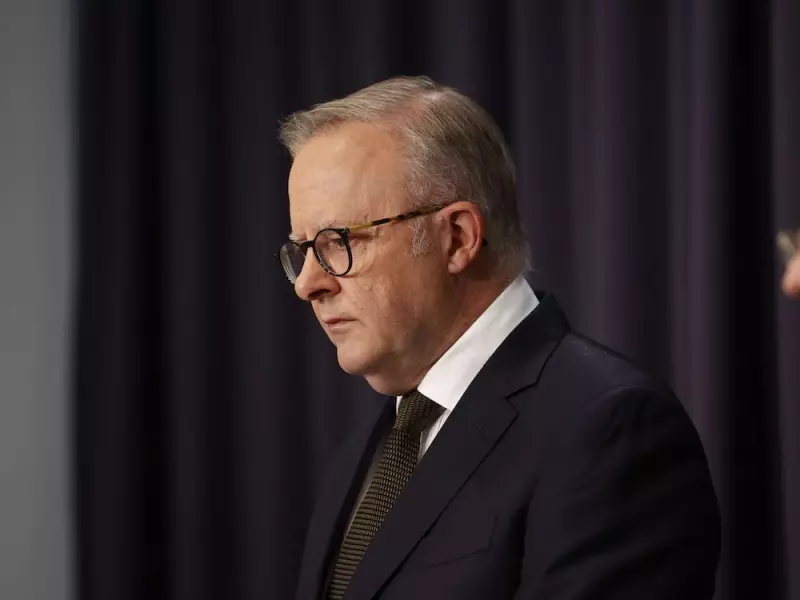
Australian Prime Minister Anthony Albanese is facing sharp criticism for his government's approach to a surge in antisemitism, with opponents accusing him of treating the issue as a public relations problem rather than an existential threat requiring decisive action.
A Defining Accusation After Bondi Beach Massacre
In the wake of a deadly two-man jihadist attack at Sydney's iconic Bondi Beach on Sunday, December 14, 2025, Australian Opposition Leader Sussan Ley delivered a pointed critique. "We have a government that sees antisemitism as a problem to be managed, not evil that needs to be eradicated," Ley stated. This remark encapsulates the central political charge against the ruling Labor Party's handling of hate-fueled violence targeting Jewish Australians.
A Historical Problem Reawakened
Analysts note that antisemitism has long been a stain on Australian society. From the time of European settlement in 1788, Jewish people faced discrimination in a largely monocultural nation. While overt bigotry subsided as Australia became more multicultural in the latter 20th century, it never disappeared. The barbaric Hamas pogrom of October 7, 2023, acted as a catalyst, bringing latent hatred back to the surface with terrifying force.

Official data confirms a dramatic escalation. In July 2025, Australia's special antisemitism envoy, Jillian Segal, reported that incidents had skyrocketed by 316 per cent in the first year following October 7. The months of October and November 2023 alone saw an increase of over 700 per cent compared to the same period in 2022. Segal attributed this explosion to extremist incitement and rampant misinformation online and in media, a phenomenon also witnessed in universities, cultural institutions, and even parliament.
Words Over Action: A Community's Frustration
Following the Bondi Beach atrocity, Prime Minister Albanese addressed the nation's approximately 100,000 Jewish citizens. "As Prime Minister, I say on behalf of all Australians to the Jewish community, we stand with you," he said. "We embrace you and we reaffirm tonight that you have every right to be proud of who you are and what you believe. You have the right to worship and study and live and work in peace and safety."
However, critics argue that such statements ring hollow against a backdrop of insufficient concrete measures. They point to a pattern of response dating back to October 9, 2023, when a pro-Palestinian mob marched on the Sydney Opera House chanting "f*** the Jews" and "gas the Jews" with little more than official condemnation following.
Throughout 2024 and 2025, major Australian cities were regularly choked by weekend pro-Palestinian protests featuring Hamas flags and calls for a global intifada. University campuses became hotbeds of abuse directed at Israel and so-called "Zios" (Zionists). In each instance, the government's primary response has been verbal, characterized by opponents as "words, words, words" accompanied by only token gestures.
The charge from figures like Terry Barnes and Opposition Leader Ley is that the Albanese government, from its initial call for Israeli "restraint" just after the October 7 massacres, has consistently prioritized political management over the forceful eradication of antisemitic hate, leaving the Jewish community feeling exposed and abandoned.