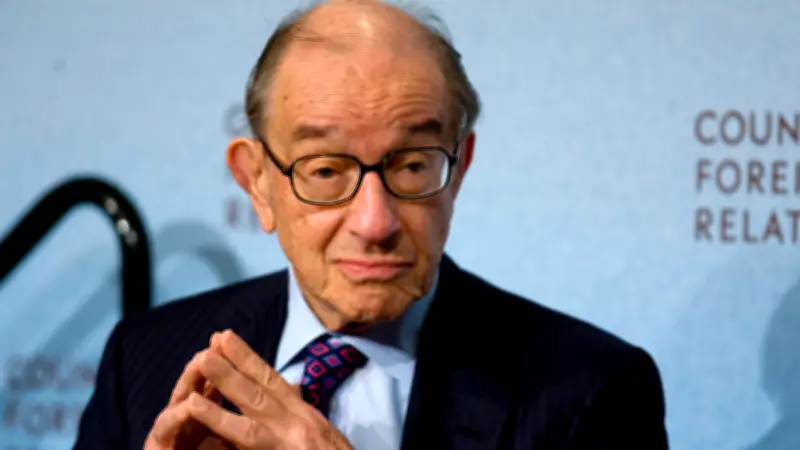
Alan Greenspan, the former chairman of the U.S. Federal Reserve who served for 19 years under four presidents, died Monday at the age of 100 from complications of Parkinson's disease, his wife Andrea Mitchell announced.
Mitchell, an NBC journalist, said in a statement: “Alan passed away at our home this morning at the age of 100 from complications of Parkinson’s disease. He was a giant of a man who helped shape the U.S. economy for decades under presidents of both parties, but was always honest in acknowledging his mistakes.” The couple married in 1997 in a ceremony officiated by Supreme Court Justice Ruth Bader Ginsburg.
Greenspan's Legacy and the Great Recession
Greenspan was first appointed Fed chairman in August 1987 by President Ronald Reagan. He navigated the stock market crash that same year and earned widespread praise during the 1990s boom. However, his tenure is also linked to the 2008 Great Recession, as critics blame his belief in light regulation for contributing to the financial crisis.

During the Great Recession, Greenspan admitted to lawmakers that he was mistaken in assuming banks would self-regulate. In 2008, he said: “Those of us who have looked to the self-interest of lending institutions to protect shareholders’ equity, myself included, are in a state of shocked disbelief.”
Early Life and Career
Born in New York on March 6, 1926, Greenspan initially pursued music, playing saxophone and clarinet in Henry Jerome and His Orchestra. He studied at Juilliard before transferring to New York University, where he earned a bachelor's degree in economics in 1948, a master's in 1950, and a Ph.D. in 1977. He cited playing alongside saxophonist Stan Getz as a turning point: “I played next to Stan Getz. I was 16, he was 15, and I played for years, side by side with him in a band and he pretty much determined that I was going to become an economist,” Greenspan told CBS Sunday Morning in 2013.
His Washington career began as chair of the Council of Economic Advisers under President Gerald Ford from 1974 to 1977. Before leading the Fed, he ran Townsend-Greenspan & Co., his economic consulting firm.
Influence of Ayn Rand
Greenspan was a close friend of libertarian writer Ayn Rand and was influenced by her free-market ideas. In his 2007 memoir “The Age of Turbulence,” he wrote: “Rand’s Collective became my first social circle outside the university and the economics profession. I engaged in the all-night debates and wrote spirited commentary for her newsletter with the fervor of a young acolyte drawn to a whole new set of ideas.” This philosophy shaped his belief in minimal bank regulation.
Fed Tenure and the Great Moderation
Greenspan succeeded Paul Volcker in 1987 and presided over the Great Moderation, a period from the mid-1980s to 2007 with low volatility, low unemployment, and low inflation. In 1996, he warned of “irrational exuberance” in the stock market, a phrase still used on Wall Street, which preceded the dot-com bubble burst and the 2008 housing crisis.
In 1998, the Fed approved the merger of Travelers Group and Citibank to form Citigroup, creating the first modern one-stop banking, insurance, and investments company. This spurred Congress to repeal the Glass-Steagall Act in 1999, dropping prohibitions against such mergers.
Mixed Opinions After the Crisis
President George W. Bush awarded Greenspan the Presidential Medal of Freedom in 2005, praising “phenomenal economic growth, high productivity, and unprecedented innovation.” However, opinions soured after the Great Recession. Critics like Stanford economist John Taylor argued that low interest rates made borrowing too easy. Others, like former Fed Vice Chair Alan Blinder, defended monetary policy but criticized loose regulation. In 2008, Blinder told The Washington Post that “lending standards were being horribly relaxed, and the Fed should have done something about that.”
In response, Greenspan published a 2010 paper asserting the crisis was not the Fed's fault. Sebastian Mallaby's 2016 biography “The Man Who Knew” described Greenspan as more focused on inflation than financial stability: “Controlling asset prices and leverage was hard; fighting inflation was easier.”

After leaving the Fed, Greenspan worked as a private consultant and wrote several books. He died at his home at age 100.