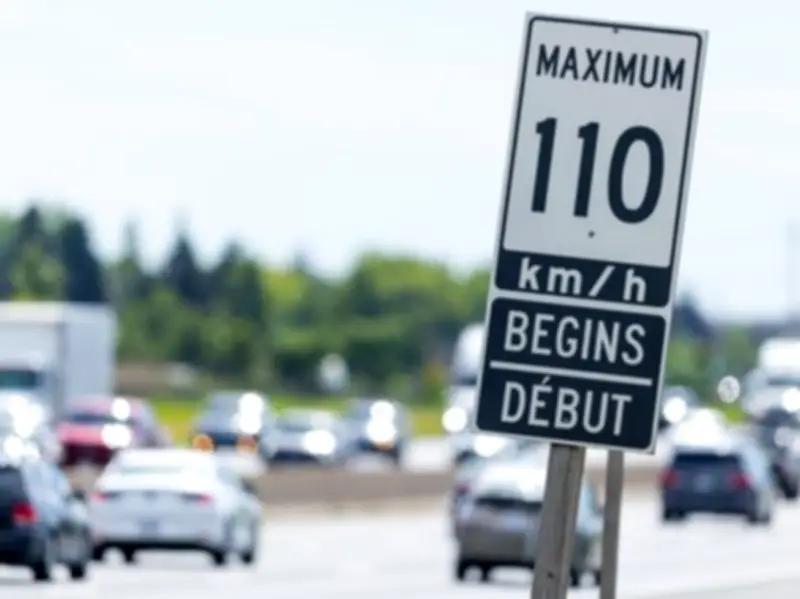
Ontario has increased speed limits to 110 km/h on an additional 938 kilometres of provincial highways, but safety experts warn that driver behaviour, not the higher speed, poses the greatest risk on the roads.
Angelo DiCicco, CEO and president of the Ontario Safety League (OSL), said in a press conference that his primary concern is driver conduct. “Many people have seen an increase in assertive, bordering on aggressive driving as vehicles have become much more competent, capable and safe,” he said. “We have larger vehicles, specifically in the wintertime, driving faster because they are a lot safer, but what happens now is that people are over driving their abilities.”
Speed limit increase details
On June 26, the province raised the speed limit from 100 km/h to 110 km/h on sections of Highways 401 and 416 in Eastern Ontario. Further increases will be applied incrementally until September 30 on sections of the Queen Elizabeth Way, and Highways 400, 402, 403, and 417. By the end of September, the 110 km/h limit will cover nearly 89% of Ontario’s highway network, totalling 938 km.

The Ontario government stated that the speed limit increase is “helping get drivers where they’re going faster and safely.” However, DiCicco emphasized that “safely” is the key word. He expressed dismay that many drivers do not understand or disregard fundamental rules of the road, such as four-way stops, roundabouts, merging safely at highway speed, and lane discipline at high speeds.
Driver fundamentals in decline
DiCicco noted a decline in driver competence since the COVID-19 pandemic. “I have noticed since COVID time the road tests have become shorter and it looks as though we have a cohort of drivers over the last six to eight years that have missed out on some of the fundamentals of the highway traffic act and the courtesies of sharing the roadway with all the other road users,” he said. He cited aggressive driving, speeding, and “flagrant disrespect for the right of way or oblivious to it” as common issues.
The OSL, founded in 1913 by business and community leaders to address public safety threats from automobiles, supports evidence-based speed limits. “The Ontario Safety League supports evidence-based speed limits for highways that were engineered to safely accommodate them,” DiCicco said. “It is not a problem with increasing the speed limit of passenger vehicles as long as the science and engineering support it, which it does.”
Potential time savings and risks
The government predicts that commuters traveling between Sarnia, Toronto, and Ottawa could save up to 30 minutes per trip. DiCicco advised that if drivers “remain patient, maintain proper following distances and avoid aggressive passing, the increased speed limit should be quite manageable, but if they become more aggressive, that they believe they have permission to drive faster, then that is when the risk increases.”
The speed limit changes build on previous increases: 10 sections of provincial highways in 2024 and six sections in 2022, which the province described as safe and successful.