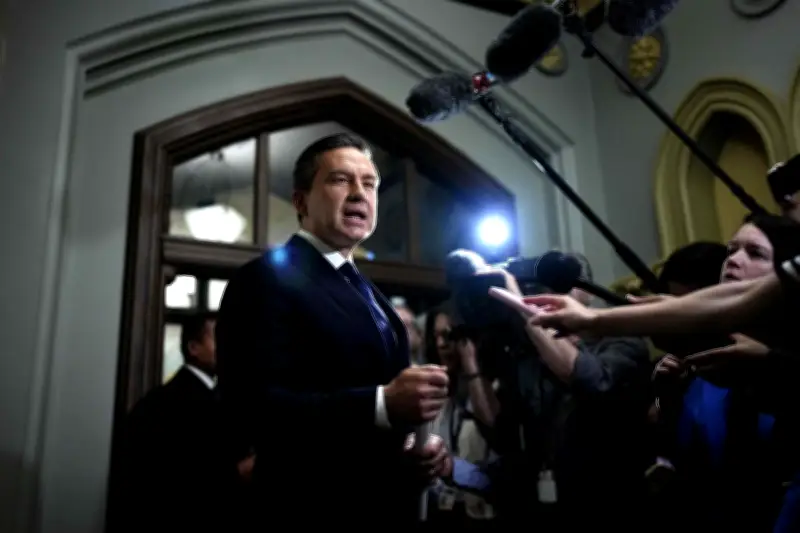
Conservative Leader Pierre Poilievre made headlines on Tuesday by declaring that Quebec separatism had been 'wiped out' during the tenure of the Conservative government. Speaking to journalists on Parliament Hill in Ottawa, Poilievre claimed that the federal Tories had successfully neutralized the sovereignty movement in Quebec. However, recent polling data suggests otherwise, indicating that support for Quebec independence remains significant among the province's electorate.
Poilievre's comments came as members of the federal cabinet began their weekly meeting nearby. The Conservative leader's assertion appears to be part of a broader strategy to shore up support in Quebec, a province that has historically been a battleground for federalist and separatist forces. Despite his confident tone, opinion polls conducted in recent months show that a substantial portion of Quebecers still favor the idea of an independent Quebec.
Political Reactions and Analysis
The statement has drawn sharp reactions from political analysts and opposition figures. Critics argue that Poilievre's claims are out of touch with the political reality in Quebec, where the separatist Parti Québécois continues to enjoy a loyal base of support. Bloc Québécois leader Yves-François Blanchet dismissed Poilievre's remarks as 'wishful thinking,' pointing to polls that show the sovereignty option polling at around 30% in Quebec.

Historical Context
The Conservative Party of Canada, under former Prime Minister Stephen Harper, made significant inroads in Quebec during the 2000s, winning a number of seats in the province. However, the sovereignty movement has never fully disappeared, with referendums in 1980 and 1995 coming close to a 'Yes' victory. Poilievre's comments may be an attempt to rally federalist voters ahead of the next federal election.
Political scientist Jean-Marc Léger noted that while support for separation has ebbed and flowed, it remains a potent force in Quebec politics. 'To say it's wiped out is an exaggeration,' Léger said. 'The underlying factors that drive separatism, such as cultural and linguistic concerns, are still present.'
Public Opinion and Polling Data
Recent surveys by reputable polling firms indicate that between 25% and 35% of Quebecers would vote 'Yes' in a hypothetical referendum on independence. This suggests that separatism is far from extinct, despite Poilievre's claims. The Conservative leader's remarks may have been intended to reassure federalist voters, but they risk alienating those who see the sovereignty movement as a legitimate political force.
In response to questions from reporters, Poilievre doubled down on his statement, insisting that the Conservative government's policies had strengthened Canadian unity. He pointed to investments in Quebec's economy and respect for provincial jurisdiction as key factors in reducing support for separatism.
Future Implications
As Canada's political landscape evolves, the issue of Quebec separatism remains a sensitive topic. Poilievre's comments could become a focal point in upcoming election campaigns, particularly if the Bloc Québécois or Parti Québécois gains momentum. For now, the debate over Quebec's place in Canada continues, with no clear resolution in sight.
The Conservative Party has not officially clarified whether Poilievre's remarks represent official party policy. However, his strong words suggest that the Tories will continue to position themselves as the party of national unity, even as polls show persistent support for Quebec sovereignty.