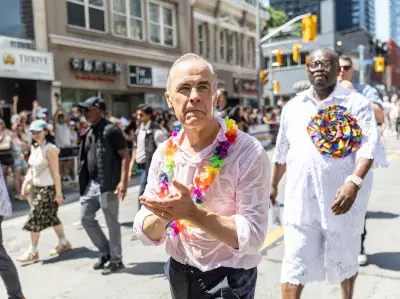
A new sexual assault accusation against Graham Platner, the progressive oysterman who won the Democratic nomination to challenge GOP Sen. Susan Collins in Maine last month, could be the final straw for the scandal-plagued campaign. Immediately after Politico on Monday reported an on-the-record testimony of Platner drunkenly entering the house of a woman he was dating and sexually assaulting her in 2021, the candidate posted a video admitting he was taking time off the campaign trail “to reflect on the best path forward.” He denied the assault allegation.
Party Leaders Call for His Immediate Withdrawal
Seemingly the entire Democratic Party apparatus, from left-wing media figures to center-left reformers to leaders of major parts of the party infrastructure, responded to the accusation with calls for him to exit the race, and for the Maine Democratic Party to step in to select a new nominee. “Platner needs to go NOW,” Adam Jentleson, a former Democratic leadership staffer who now runs the heterodox Searchlight Institute, wrote on social media. “Collins is cackling … Dems have a bunch of strong replacements - pick one ASAP so we can get on offense against Collins. Platner lied to a lot of people and isn’t entitled to drag this out.”
By 7 p.m., both the Maine Democratic Party and the Democratic Senatorial Campaign Committee had called on him to drop out. “The Maine Democratic Party leadership stands with women and survivors, and that principle does not bend based on party affiliation,” the party’s chair, vice-chair and executive director, wrote in a statement. “We respect the women who made the hard decision to come forward. Speaking up is often costly.”

Platner’s Response and Political Calculus
In the two-minute video posted after the Politico report, Platner left open the possibility that he would leave the race, implying a key part of his calculus would be whether he thought he could still defeat Collins in November. “Regardless of the inaccuracy of the reporting, but mindful of the political reality it will inflict, we are taking the time to reflect on the best path forward for the state that I love, the people that I love, the movement I belong to, and the goal of defeating Susan Collins,” Platner said. “Those were the goals when we launched this campaign, and they remain my goals today.”
Beyond the scandal, two Democrats with knowledge of the situation who requested anonymity to speak frankly said Platner’s fundraising slowed in the weeks since the revelation he had sent sexually explicit text messages to women who were not his wife. His campaign put out a memo last week suggesting they need more help from outside groups to match GOP spending.
Stakes for Senate Control
Democrats need to defeat Collins, a five-term moderate, to have any hope of winning back the Senate in November. Recent polls have shown Platner in a close race with the Republicans, but some have suggested a different Democratic nominee would perform better. A New York Times/Siena College survey released last week, for instance, showed Platner leading Collins 49% to 47%, while Democrats had a 53% to 42% lead on the generic ballot, and 54% of registered voters said they would prefer Democrats control the Senate.
Platner has until July 13 to drop out of the race, and the state party would then have until July 27 to select a replacement nominee.
Potential Replacement Candidates
Based on conversations with five Democratic operatives in D.C. and Maine ― all of whom requested anonymity to speak frankly about the party’s options ― there are four major names in contention at the moment: former state Senate President Troy Jackson, Maine Beer Company Founder Dan Kleban, former state Centers for Disease Control leader Nirav Shah and Maine Secretary of State Shenna Bellows. All were candidates in this year’s race for governor except for Kleban, who ended his brief run for Senate after Gov. Janet Mills entered the race. All the operatives also said any selection would be unpredictable and surprise candidates could emerge.

Jackson is considered the closest Democrats could get to a scandal-free version of Platner. A logger who represented a district on Maine’s border with Canada and won it repeatedly even as it voted for Collins and for President Donald Trump, said he is close with organized labor and shares Platner’s populist politics and the backing of Sen. Bernie Sanders (I-Vt.). While Jackson finished third in the state’s ranked-choice vote for governor, one operative suggested he would have a potential leg up because selecting him would not “reverse the progressive victory in the primary,” an important goal for party unity and potentially for earning the buy-in of Platner to drop out of the contest. However, it’s not clear if Jackson would have interest in the job. He turned down the opportunity to run in the state’s 2nd Congressional District after Rep. Jared Golden (D-Me.) announced his retirement, saying he was focused on state rather than federal politics. He also is not seen as an especially compelling speaker.
Shah, meanwhile, finished in second place in the primary, and a source familiar with the situation said he is receiving calls encouraging him to throw his hat into the ring. (He finished first in the initial voting and would’ve won the nomination in most states.) He is, however, significantly more moderate than Platner. He has high name identification from his time leading the state’s public health apparatus during the COVID pandemic, and proved himself to be a strong fundraiser. Kleban could face similar ideological objections — he endorsed Mills in the Senate primary — though he’s far less defined. But he’s shown an interest in the job. Bellows, who finished fourth in the governor’s race and was the party’s candidate against Collins in 2014, would likely try to pitch herself as acceptable to the entire party. Detailed breakdowns of the ranked-choice voting outcomes have shown if she had received just a few hundred more votes in the second round of tabulation to pass Jackson, she would’ve ultimately won the governorship.
One Maine Democrat who almost certainly won’t end up with the nomination is 78-year-old Mills, whose uninspiring and reluctant campaign left few people convinced she could defeat Collins in November. “I’m not sure anyone is interested in that,” said one Maine Democratic operative. “And that includes Gov. Mills.”