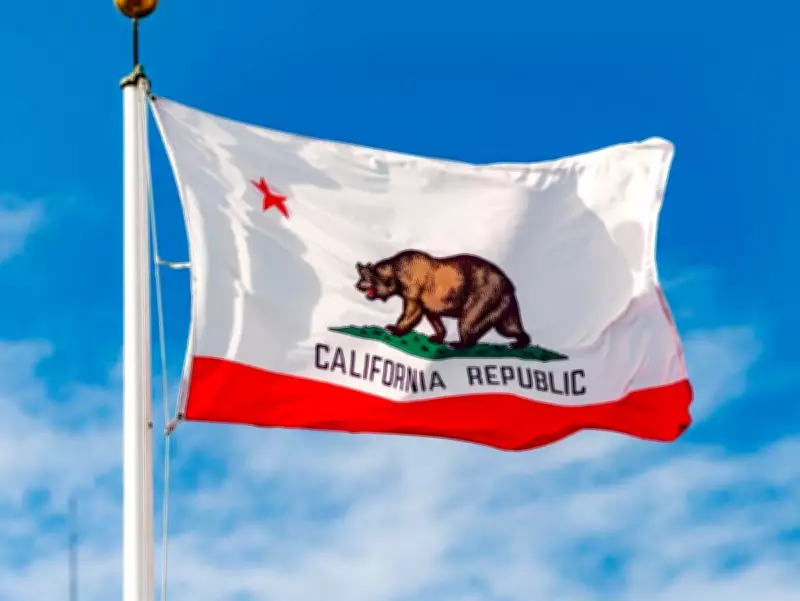
California's Political Landscape Faces Unprecedented Shift
In a development that seems almost scripted for Hollywood, California—a state long dominated by Democratic politics—is witnessing a remarkable political twist. As the 2026 gubernatorial race heats up, there is a growing possibility that two Republican candidates could face off in the November general election, a scenario not seen in over a decade.
The Mechanics of an Open Primary System
California operates under an open primary system, where the top two finishers in the June primary, regardless of party affiliation, advance to the general election. Currently, eight Democrats and two Republicans have entered the race. With Democratic support fragmented among multiple candidates, the two Republicans—Riverside County Sheriff Chad Bianco and Steve Hilton, endorsed by former President Donald Trump—have emerged as frontrunners in early polling.
Adding to the intrigue, neither Republican candidate secured the 60% support needed to gain an official party endorsement at the recent Republican convention. In a surprising turn, Hilton, despite Trump's backing, trailed Bianco by five points in the convention vote.

Democratic Challenges and Candidate Withdrawals
The Democratic field has faced its own upheaval. Seven-term Representative Eric Swalwell, widely considered a leading Democratic contender, withdrew from the race following allegations of sexual misconduct. This departure further complicates the Democratic Party's efforts to consolidate support and could enhance Republican chances in the primary.
California has not had a Republican governor since Arnold Schwarzenegger left office in 2011. The state's congressional delegation—the largest in the nation—includes 52 House members, with 46 Democrats, and two Democratic senators. The state legislature is also firmly under Democratic control, making the potential Republican resurgence even more noteworthy.
Economic and Social Context of the Race
Beyond the political drama, California grapples with significant economic and social challenges. With a $4.1-trillion economy, it ranks among the world's largest, yet it faces a persistent exodus of businesses and residents. According to the Public Policy Institute of California, the state has experienced more departures than arrivals annually for the past 25 years, with 10 million people leaving and only 7 million arriving between 2010 and 2024.
Major corporations such as McKesson, Chevron, Tesla, Oracle, CBRE, Charles Schwab, and Hewlett Packard Enterprises have relocated out of California in recent years, citing high costs of living and doing business driven by taxation and regulation. Governor Gavin Newsom has faced criticism for his response to these trends; for instance, when Bed Bath & Beyond announced it would not open stores in California due to the challenging business environment, the governor's office dismissed the company as irrelevant.
Statistical Insights into California's Struggles
Joel Kotkin of Chapman University and the University of Texas-Austin highlights several alarming statistics:
- California accounts for roughly half of the nation's homeless population.
- The state has the highest unemployment rate and the highest cost-of-living adjusted poverty rate in the country.
- Over the last decade, California has lost 1.6 million above-average paying jobs while creating five times as many low-wage as high-wage jobs.
In response, Newsom has allocated $19 million in taxpayer funds to a New York PR firm to develop a campaign promoting the state's image. However, a Public Policy Institute of California survey reveals that only one in three Californians believes the state is a good place to achieve the American dream.
Implications for National Politics
California often serves as a bellwether for national trends. The current political and economic turmoil may signal broader changes underway in the United States. As Star Parker, founder of the Center for Urban Renewal and Education, notes, this period of chaos could herald a rebirth and restoration of founding principles, not just in California but across the nation.

The 2026 gubernatorial race in California is more than a local contest; it is a microcosm of the country's political realignment and economic challenges. With the primary approaching, all eyes are on the Golden State to see if Republicans can capitalize on Democratic disarray and shifting public sentiment to reclaim the governor's mansion after 15 years.