The United States government has formally acknowledged its role in a catastrophic mid-air collision between a commercial airliner and a military helicopter over the nation's capital, an incident that claimed the lives of 67 people. The admission comes nearly a year after the disaster, which occurred on February 4, 2025, near Ronald Reagan Washington National Airport.
The Tragic Incident and Immediate Aftermath
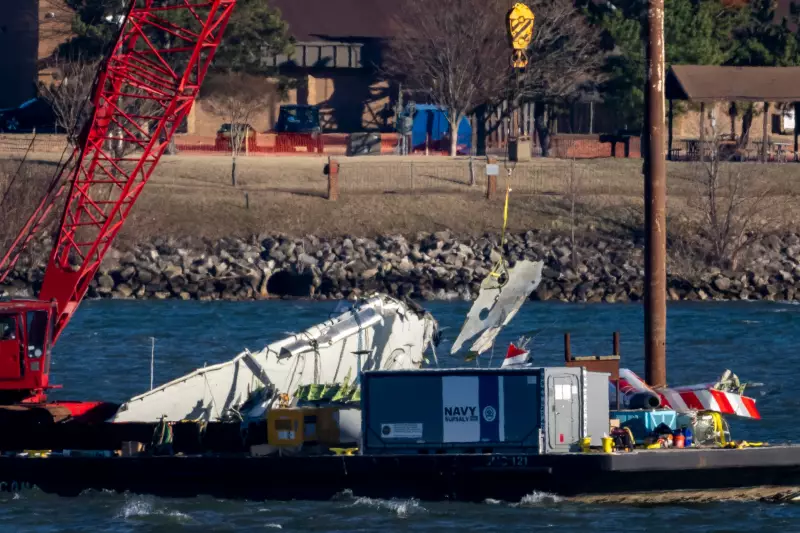
On that Tuesday in early February, an American Airlines passenger jet and a U.S. Army Black Hawk helicopter collided in the skies above the Potomac River in Arlington, Virginia. The impact sent wreckage plunging into the waterway, triggering a massive emergency response. Salvage operations began immediately, with poignant images showing recovery crews lifting pieces of debris from the river onto waiting vessels. The scale of the tragedy was immense, with no survivors from either aircraft.
Government Acknowledgment and Investigation
In a significant development, U.S. authorities have now conceded that government actions were a causative factor in the collision. While the full report from the National Transportation Safety Board (NTSB) is anticipated, preliminary findings point to a breakdown in coordinated air traffic control and military flight operations in the restricted airspace around Washington, D.C. The admission confirms long-held suspicions about systemic failures in managing the complex air corridors in one of the world's most sensitive flight regions.

The death toll of 67 marks this as one of the deadliest aviation accidents on U.S. soil in recent decades. The incident involved both civilian and military aircraft, raising profound questions about the protocols governing shared airspace. The Potomac River, a major geographical feature in the capital region, became the site of a prolonged recovery mission as investigators worked to piece together the sequence of events from the scattered wreckage.
Broader Implications and Ongoing Scrutiny
This government admission is expected to have far-reaching consequences for aviation policy, military-civilian coordination, and victim compensation. Families of those lost have awaited this moment of accountability, though it comes with the heavy weight of confirmed negligence. The disaster has already prompted internal reviews within the Federal Aviation Administration (FAA) and the Department of Defense regarding real-time communication and flight path deconfliction procedures.
The location of the crash, adjacent to a major international airport and in the heart of the American political landscape, has amplified scrutiny. The date of the collision, February 4, 2025, is now a somber marker for aviation safety advocates. As the official investigation continues to finalize its report, the focus shifts to implementing concrete changes to prevent a repeat of such a devastating failure, ensuring the safety of the thousands of passengers and crew who traverse the busy capital skies daily.