The recent arrest of alleged members of a radical group in the United States should serve as a stark warning to Canadian authorities and the public about the threat of domestic extremism, argues commentator Terry Newman. The case underscores the dangers of rhetoric that calls for violent revolution, rhetoric that Newman contends is echoed by some activist circles within Canada.
FBI Disrupts Alleged Bomb Plot
On Monday, December 18, 2025, the Federal Bureau of Investigation announced a significant security operation. Four individuals allegedly belonging to the Turtle Island Liberation Front (TILF) were taken into custody. They are accused of planning coordinated bombing attacks targeting several companies in southern California, timed for New Year's Eve. A fifth alleged member of the same group was arrested separately in New Orleans for planning an unrelated attack.
The FBI described TILF as an anti-capitalist, anti-government, and pro-Palestinian organization. The group's alleged plans have brought its ideology and online presence under intense scrutiny.

The Radical Online Footprint of TILF
An examination of the group's social media accounts reveals a relatively new entity. Its public posts only date back to July of this year. The TILF Facebook page references an Instagram account for a Los Angeles chapter, though it remains unclear if other chapters exist in the U.S.
The group's first major Facebook post, dated October 4, 2025, serves as a mission statement. It declares that "peaceful protest will never be enough" and the "only way out is through resistance." It frames its struggle as being "up against fascist colonizers" and urges followers to "stop marching in parades and fight back."
The statement elaborates, claiming there are "no morals for us to appeal to, no sense of justice or what’s right" and that society cannot "vote ourselves out of a mass colonizer occupation." It explicitly states its goals: to "free occupied turtle island from the illegal american empire" and to "Free Palestine." It posits that freeing the world from American imperialism is the sole path to a safe future.
Extremist Rhetoric and Canadian Parallels
Other posts from the group escalate the rhetoric. One simply declares, "Death to America." A subsequent post attempts to clarify, stating that such calls "doesn’t mean the displacement or harm of non Indigenous citizens." Another post from October 6 is unequivocal: "If you truly want change, there is only one solution. Revolution."
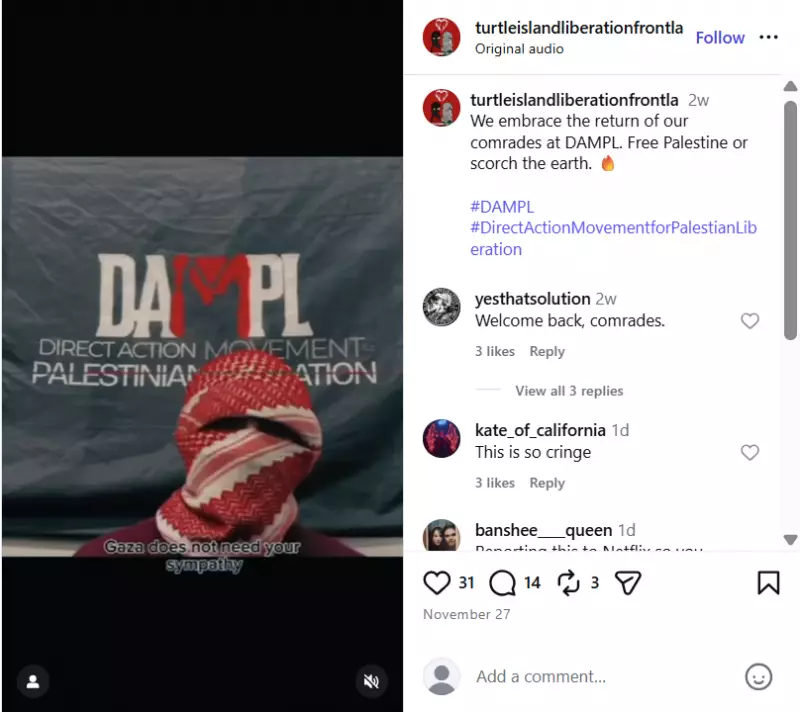
On Instagram, the group's content aligns with this militant stance. One video post features an individual in a keffiyeh in front of a banner for DAMPL (Direct Action Movement Palestinian Liberation) with a caption embracing the "return of our comrades." The video, set to music, criticizes onlookers at an immigration detention center and ends with the message, "Gaza does not need your sympathy."
Terry Newman argues that the ideology and language promoted by TILF are not isolated to the United States. He warns that Canada is also home to groups espousing similar extremist pro-Palestinian rhetoric. The alleged terror plot in California, he contends, is a clear signal that Canadian security agencies and the public cannot afford to dismiss such violent revolutionary talk as mere online posturing. The incident raises urgent questions about monitoring domestic extremism and the potential for radicalization within activist movements that reject democratic processes in favor of violent upheaval.