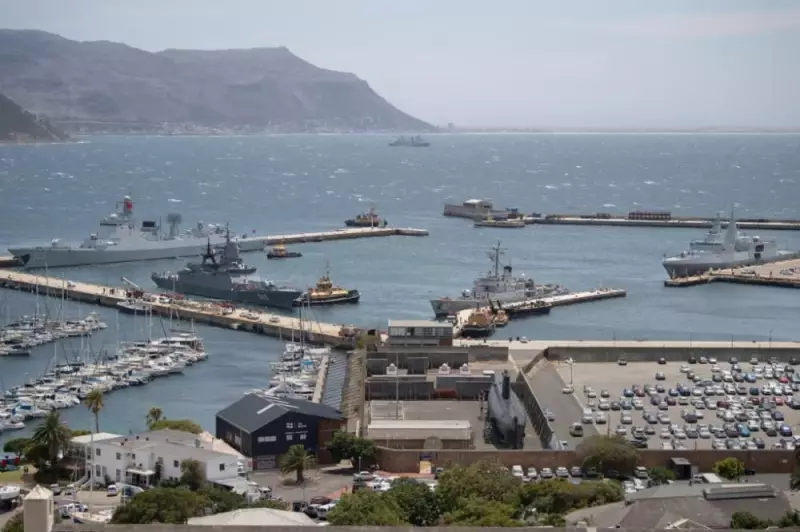
South Africa has commenced a significant week-long naval exercise with military forces from Russia, Iran, and China, defending the controversial manoeuvres as a necessary response to growing instability on the world's oceans.
A Show of BRICS Solidarity Amid Tensions
The drills, dubbed 'Will for Peace 2026', began on Saturday off the South African coast. Captain Nndwakhulu Thomas Thamaha, South Africa's joint taskforce commander, stated at the opening ceremony that the activities were more than a simple military display. He framed them as a vital demonstration of collective resolve among participating nations, primarily from the expanded BRICS bloc.
"In an increasingly complex maritime environment, cooperation such as this is not an option, it is essential," Thamaha asserted. He emphasized the goal was to "ensure the safety of shipping lanes and maritime economic activities."

Timing Follows U.S. Seizure of Russian Tanker
The launch of these multinational exercises comes just days after a provocative move by the United States. American authorities seized a Russian-flagged oil tanker in the North Atlantic. The U.S. justified the action by claiming the vessel was carrying crude oil destined for Venezuela, Russia, and Iran in direct violation of Western sanctions.
This seizure followed a recent American raid that toppled Moscow's ally, Nicolas Maduro, in Venezuela. The proximity of these events casts the South African-led drills in a sharper geopolitical light, highlighting the deepening divide between Western powers and the BRICS alliance.
Participants and Observers in the Drills
The exercises are led by China and feature a notable assembly of naval assets:
- China and Iran deployed destroyer warships.
- Russia and the United Arab Emirates sent corvette vessels.
- Host nation South Africa dispatched a frigate.
Furthermore, the drills included observers from Indonesia, Ethiopia, and Brazil. The participant list reflects the recent expansion of the BRICS group, which now includes Egypt, Ethiopia, Iran, Saudi Arabia, the United Arab Emirates, and Indonesia alongside its original members: Brazil, Russia, India, China, and South Africa.
Mounting U.S. Criticism and South Africa's Stance
Washington has reacted with strong disapproval. The United States has accused South Africa and the broader BRICS bloc of pursuing 'anti-American' policies. As a warning, U.S. officials have suggested that member states could face an additional 10 percent tariff on top of existing duties.
This is not the first time South Africa has drawn Washington's ire for its military partnerships. The country faced similar criticism for hosting naval drills with Russia and China in 2023, which coincided with the first anniversary of Moscow's invasion of Ukraine. The three nations first conducted joint naval exercises in 2019.
Additional friction stems from South Africa's close ties with Russia and other foreign policy decisions, most notably its recent move to bring a genocide case against Israel, a key U.S. ally, at the International Court of Justice regarding the Gaza war.
The 'Will for Peace 2026' drills were initially scheduled for November but were postponed due to a scheduling conflict with the G20 summit in Johannesburg—a summit that was notably boycotted by the United States.