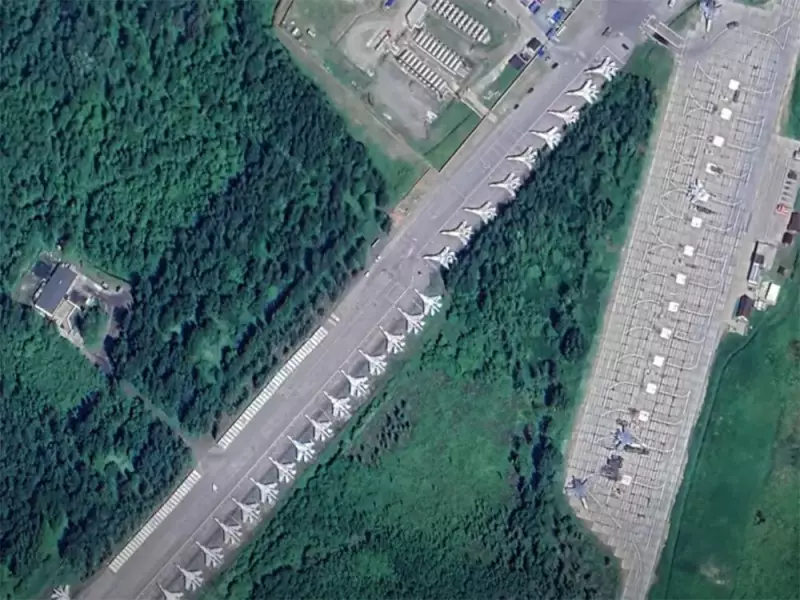
Commercial satellite imagery has provided a stark and detailed look at a significant Russian military buildup along NATO's eastern frontier, presenting a sobering picture for European security. A private group of intelligence analysts compiled the evidence, revealing extensive infrastructure and weaponry positioned alarmingly close to the borders of Poland, Lithuania, and Finland.
A Graphic Overview of the Buildup
The findings, presented in a video to the Toronto-based Mackenzie Institute think tank in December 2025, stitch together commercial satellite photos and other open-source intelligence. The analysis documents sprawling training sites, massive fuel and oil storage depots, and countless anti-aircraft missile launchers. It also shows specialized infrastructure like ponds for testing amphibious vehicles.
A focal point is the Kaliningrad enclave, a Russian territory sandwiched between Poland and Lithuania. The imagery confirms that Russia has stationed approximately 70 fighter jets and ground-attack aircraft at an airbase there, whose runway has been recently extended. Perhaps most concerning are reports of nuclear-capable missiles in the region that could reach Western European capitals within minutes.

Analysts Aim to Shift North American Focus
The group behind the research, including writer and geopolitical blogger Jeff Nyquist, hopes their work will redirect some North American attention. They argue that while the war in Ukraine dominates headlines, the concurrent Russian military consolidation elsewhere in Eastern Europe has been largely overlooked.
"I think people need to know Russia is not this benign thing," Nyquist stated during the Toronto presentation. "They want to dominate Europe, they want the United States to not be a great power any more… America can't survive losing its allies in Europe. People need to understand what this means." Nyquist expressed particular concern about shifting political attitudes in the United States, suggesting the MAGA movement has been "obviously penetrated by the Russians."
Expert Analysis: Paranoia or Preparation?
Frédéric Labarre, a professor at the Royal Military College and a NATO-Russia relations expert, reviewed the analysis and deemed it "pretty good." He emphasized the value of such public intelligence in signaling to Moscow that its movements are being monitored. "Their work is extremely, extremely useful if it gets published because it's a way of telling the Russians 'We see you. And whenever you move, we know where you're going,'" Labarre noted.
However, Labarre offered a nuanced interpretation of Russia's intentions. While acknowledging the scale of the buildup, he is not convinced it signals an imminent plan to invade NATO territory. He suggests much of the equipment is of poor quality and that the posture is likely more defensive, rooted in a deep-seated historical mindset. "You cannot express this to a Russian, who has an ingrained paranoia about encirclement. This is not new. This is centuries-old, this fear of being encircled," Labarre explained, noting that NATO does not pose a genuine military threat to Moscow.
The revelation comes amid a complex geopolitical climate. The research was released in January 2026, as former U.S. President Donald Trump, who has courted Russian leader Vladimir Putin and halted direct military aid to Ukraine, recently took dramatic actions like the capture of Venezuelan President Nicolas Maduro. These events have fueled concerns about America's commitment to countering Russian influence in Europe, making the visual evidence of the military buildup on NATO's doorstep all the more critical for public and policy discourse.