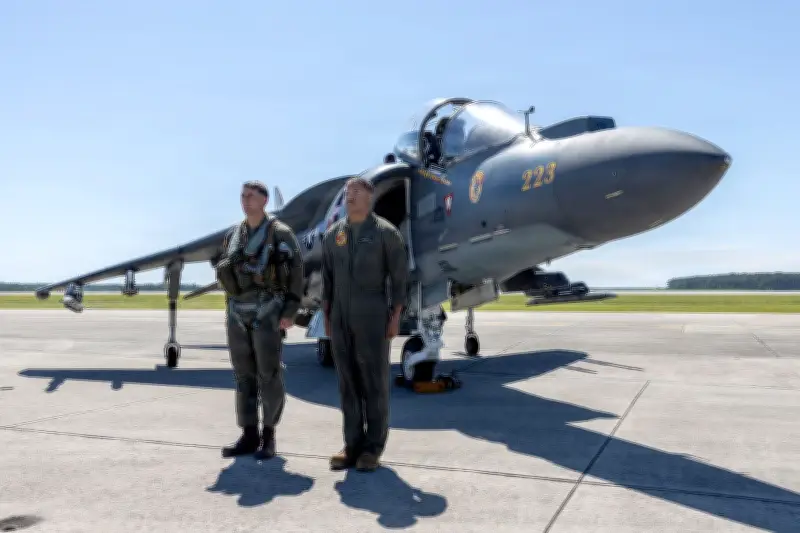
The United States Marine Corps officially retired the AV-8B Harrier II on June 3, 2026, marking the end of an era for the first fighter jet that did not require a runway for takeoff and landing. The ceremony took place at Marine Corps Air Station Cherry Point in North Carolina, where Marine Attack Squadron 223, also known as the Bulldogs, conducted its final flight with the iconic aircraft.
A Historic Aircraft
The AV-8B Harrier II, a single-engine jet capable of short takeoff and vertical landing (STOVL), revolutionized military aviation by allowing operations from amphibious assault ships, damaged runways, and even forward operating bases with minimal infrastructure. Its unique design, featuring vectored thrust nozzles, enabled it to hover and land vertically like a helicopter while retaining the speed and agility of a fixed-wing fighter.
First introduced in the 1980s, the Harrier served in numerous conflicts, including the Gulf War, the Balkans, Iraq, and Afghanistan, providing close air support and reconnaissance. The Marine Corps operated the Harrier for over four decades, with multiple upgrades enhancing its avionics, weapons systems, and sensors.

Retirement Ceremony
During the retirement ceremony, Marine Corps Lt. Col. John B. Cumbie, commanding officer of Marine Attack Squadron 223, and Cpl. Myles J. Howard, a fixed-wing aircraft mechanic, stood at attention in front of the aircraft. The event honored the legacy of the Harrier and the thousands of Marines who maintained and flew it. The aircraft will be replaced by the F-35B Lightning II, which also features STOVL capability but offers advanced stealth, sensor fusion, and network connectivity.
The retirement of the Harrier marks a significant milestone in Marine Corps aviation, as the service transitions to a more modern and capable fleet. The F-35B, part of the Joint Strike Fighter program, has been gradually replacing older aircraft across the U.S. military and allied nations.
Legacy and Impact
The Harrier's ability to operate without a runway made it invaluable in expeditionary missions where traditional airfields were unavailable or compromised. Its retirement closes a chapter in aviation history, but its influence on future aircraft design remains significant. The F-35B builds upon the STOVL concept with enhanced performance and interoperability.
The Marine Corps plans to preserve some Harrier aircraft for museum displays, ensuring that future generations can appreciate this pioneering warplane. The final flight of the Bulldogs' Harriers was a bittersweet moment for the aviation community, celebrating a remarkable aircraft that served with distinction.