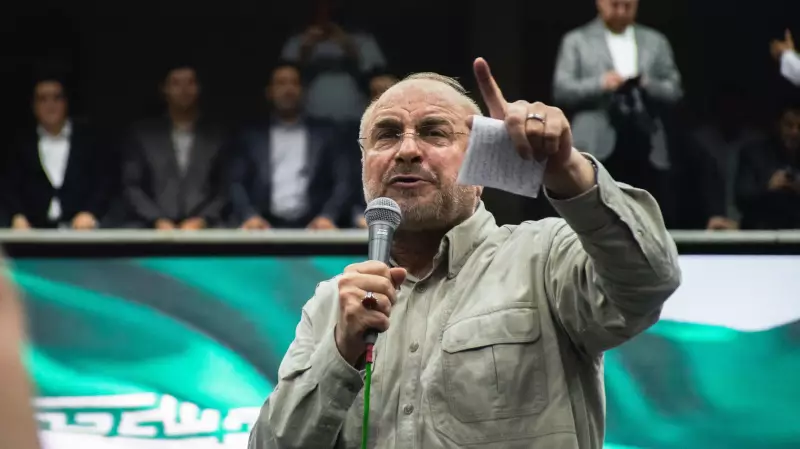
Iran's parliament speaker issued a stark warning to the United States and Israel on Sunday, declaring their military assets as "legitimate targets" should Washington launch strikes against the Islamic Republic. The threat from Mohammad Bagher Qalibaf comes as nationwide protests challenging Iran's theocratic government have surged into a third week, with activists reporting at least 116 people killed and thousands detained.
Parliamentary Threats and U.S. Warnings
During a live broadcast of the Iranian parliament session, hard-line speaker Mohammad Bagher Qalibaf delivered a speech praising police and the Revolutionary Guard for their handling of the unrest. He then directed a pointed threat at Israel, which he called "the occupied territory," and U.S. forces in the region.
"In the event of an attack on Iran, both the occupied territory and all American military centers, bases and ships in the region will be our legitimate targets," Qalibaf stated. He added that Iran would not limit itself to retaliating after an attack but would act preemptively based on "any objective signs of a threat." Lawmakers subsequently rushed the dais, chanting "Death to America!"

This escalation follows reports that U.S. President Donald Trump has been presented with military options for a potential strike on Iran, though he has not made a final decision. Trump has publicly supported the protesters via social media, stating "Iran is looking at FREEDOM, perhaps like never before. The USA stands ready to help!!!" The U.S. State Department separately cautioned, "Do not play games with President Trump. When he says he'll do something, he means it."
Protests Persist Amid Information Blackout
The protests, which began on December 28 initially over the collapse of the Iranian rial currency, have intensified into a direct challenge to the country's leadership. With internet access severely restricted and phone lines cut, verifying events on the ground has become increasingly difficult for observers outside Iran.
According to the U.S.-based Human Rights Activists News Agency, the death toll has climbed to 116, while approximately 2,600 people have been detained. There are growing fears that the information blackout could enable a more severe crackdown by security forces.
Videos smuggled out of the country, likely via Starlink satellite systems, showed ongoing demonstrations. In Tehran's Punak neighborhood, protesters waved lit mobile phones and banged metal objects as fireworks exploded. In Mashhad, Iran's second-largest city, footage depicted confrontations with security forces and flaming debris blocking streets. Protests were also reported in the cities of Kerman and Kermanshah.
Official Response and Regional Stance
Iranian state television aired segments showing calm streets in several cities, though notably omitted footage from Tehran and Mashhad. It also broadcast pro-government rallies and funerals for slain security force members, reporting that six were killed in Kermanshah, seven in North Khorasan province, and 13 people died in violence in Fars province.
Top security official Ali Larijani appeared on state TV to accuse some demonstrators of actions "very similar to what ISIS does." Even reformist President Masoud Pezeshkian, who had previously sought to ease public anger, adopted a harder line in a Sunday interview, stating that while people's concerns should be addressed, the "higher duty is not to allow a group of rioters to come and destroy the entire society."
The regional posture remains tense. The U.S. military has stated its forces in the Middle East are "postured with forces that span the full range of combat capability." An Israeli official, speaking anonymously, said Israel is "watching closely" the situation, noting that Prime Minister Benjamin Netanyahu recently discussed Iran with U.S. Secretary of State Marco Rubio.
The final decision for any military action by Iran rests with the country's 86-year-old Supreme Leader, Ayatollah Ali Khamenei. The protests continue to represent one of the most significant sustained challenges to Iran's theocratic rule in recent years.