Inside Gaza's Yellow Zone: The IDF's Critical Defense Against Hamas Tunnel Warfare
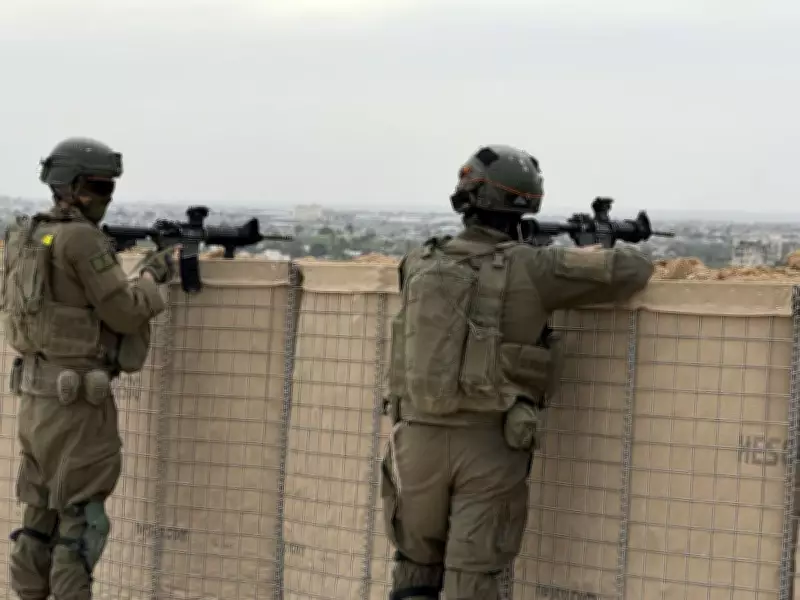
Vivian Bercovici recently ventured deep into the Gaza Strip, embedded with the Israel Defense Forces within the Israeli-controlled "yellow zone." This area, marked by bold yellow flags, represents the frontline established under the October 2025 ceasefire agreement, separating Israeli and Hamas-controlled territories. For several hours on a Thursday afternoon, Bercovici witnessed firsthand the tense reality along this demarcation line.
The Constant Threat at the Yellow Line
Despite the clear visual markers, Hamas terrorists attempt to cross this boundary almost daily, targeting IDF troops stationed at forward bases. At an IDF base overlooking Dir al-Balah in central Gaza, spokesperson Lt.-Col. Nadav Shoshani briefed foreign media, confirming that all recent attacks on this specific base had been successfully repelled. "Hamas remains very active targeting our troops … and trying to rearm," Shoshani stated. "We have found tunnels, IEDs and new weapons that they have deployed in this area."
These hastily constructed IDF bases run the entire length of the yellow line, with protective berms built following repeated Hamas assaults. The soldiers stationed there monitor a forward security zone, creating a crucial geographic buffer between Hamas and Israel. As long as Hamas maintains its armed and hostile posture, this narrow strip of land remains imperative for Israeli security.

The Underground Labyrinth of Hamas Tunnels
While specific military details are classified, Shoshani revealed a map showing the Israeli-controlled yellow zone heavily marked with holes, each indicating a tunnel shaft discovered by the IDF in recent months. Every shaft leads to an extensive underground network comprising hundreds of kilometers of war infrastructure. "Some tunnels are 70-metres deep. They connect to others. They have street names, underground. There are signs showing the turn number in the tunnel," Shoshani explained, confirming that Hamas meticulously maps and documents this maze.
The tunnel system varies widely in construction. Some passages are narrow, requiring crawling, while others are tall enough for standing. Certain sections feature tile and concrete finishes, complete with generators, lighting, and air conditioning, whereas others remain primitive. Much of the construction material was sourced from foreign aid with minimal restrictions.
Ongoing Discoveries and Security Challenges
In January alone, troops near the base located and dismantled an approximately one-kilometer-long tunnel used for storing weapons and hiding fighters. Throughout the conflict, many Israeli hostages were held captive in these tunnels and above-ground dwellings in the area, with the IDF carefully avoiding operations where hostages were believed to be located.
"With every passing week, we find more tunnels and shafts," Shoshani noted. "It's an incredible threat and challenge we must deal with. We've found a lot, but a lot remains." This ongoing discovery process highlights the persistent security challenge, even as U.S. President Donald Trump's 21-point peace plan prioritizes Hamas disarmament—a term the terror group now claims it never agreed to.
The yellow zone represents more than just a ceasefire line; it is a critical defensive barrier where Israeli soldiers stand as the last line of protection against potential massacres, confronting an ever-expanding underground threat that continues to evolve beneath the surface of Gaza.