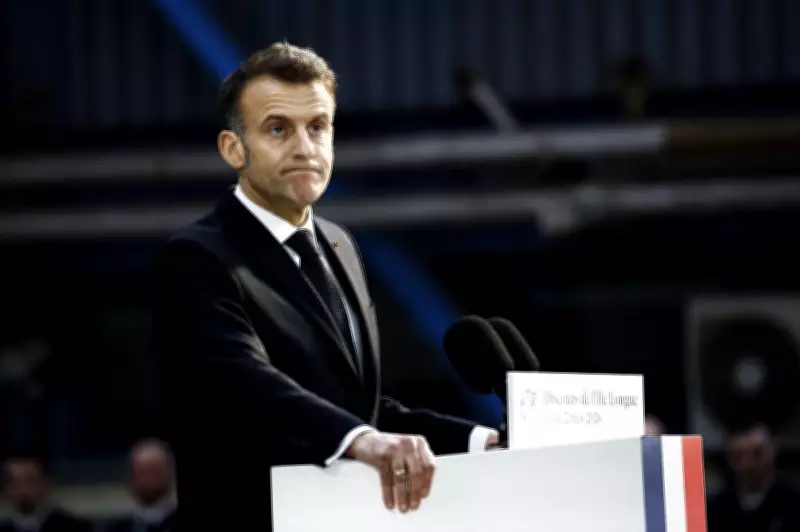
In a significant strategic shift, French President Emmanuel Macron announced on Monday that France will expand its nuclear arsenal for the first time in decades and extend its nuclear deterrent to European allies. The announcement, made at France's Ile Longue nuclear submarine base on the Atlantic Coast, marks a pivotal moment in European defense policy aimed at bolstering independence and security.
A New Nuclear Strategy for Europe
Macron detailed that France will allow the temporary deployment of its nuclear-armed aircraft to allied countries, a move designed to enhance collective deterrence. "To be free, one needs to be feared," Macron stated, emphasizing the rationale behind this enhanced posture. This initiative represents the first time France has permitted such deployments, signaling a departure from its traditionally insular nuclear policy.
Key Elements of the Announcement
The strategy includes several critical components:

- Increased Arsenal: France will augment its nuclear stockpile, which currently stands at approximately 290 warheads—the largest in Europe outside of Russia.
- Allied Deployment: Strategic air forces may be stationed in partner nations, though France retains sole decision-making authority over nuclear use.
- Enhanced Cooperation: Non-nuclear allies can participate in deterrence exercises and nuclear-related activities, fostering deeper integration.
Drivers Behind the Decision
Macron cited multiple factors influencing this strategic evolution:
- The ongoing full-scale Russian invasion of Ukraine, which has heightened European security concerns.
- Escalating tensions with U.S. President Donald Trump, creating uncertainty over traditional alliances.
- The emergence of regional powers and advancements in competitors' defense systems.
- Risks associated with nuclear proliferation and potential coordination among adversaries.
These developments, Macron argued, necessitate a reinforced French nuclear capability to ensure stability and deterrence in an increasingly volatile global landscape.
European and International Reactions
European partners have largely welcomed France's new strategy. As the European Union's sole remaining nuclear power since the United Kingdom's departure in 2020, France's enhanced role is viewed as crucial for regional security. The UK, while no longer an EU member, remains a key NATO ally and has coordinated with France through a joint declaration adopted in July, allowing for independent yet synchronized nuclear forces.
France has initiated discussions with several nations, including the UK, Germany, Poland, the Netherlands, Belgium, Greece, Sweden, and Denmark, to explore collaborative opportunities under this framework.
Sovereignty and Control
Despite the extended deterrent, Macron was unequivocal about maintaining French sovereignty. "France alone will decide on the use of nuclear weapons," he asserted, clarifying that while allies may host French assets, no shared decision-making will occur. This principle ensures that the president, as commander-in-chief, retains exclusive authority over nuclear engagements.
Comparative Nuclear Context
France's arsenal, though expanding, remains modest compared to global powers. Russia possesses an estimated 5,459 warheads, while the UK maintains around 225. Several other European countries host U.S. warheads as part of NATO's nuclear sharing agreements, but France's independent stance distinguishes its approach.
This announcement precedes recent hostilities with Iran and aligns with broader efforts to address evolving security challenges. By strengthening its nuclear posture, France aims to provide a reliable deterrent for Europe, reinforcing its commitment to regional stability amid geopolitical uncertainties.