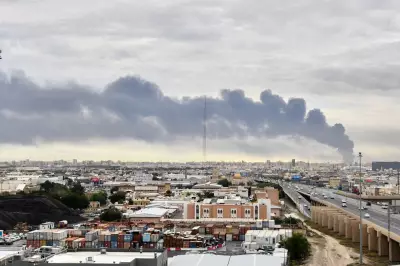
Cartel Drone Incident Forces El Paso Airport Shutdown, Exposes Growing US-Mexico Tensions
The chaotic overnight closure of El Paso International Airport on Tuesday has brought into sharp focus the escalating use of unmanned aircraft by Mexican drug cartels and the crackling diplomatic tensions between the United States and Mexico over how to address this emerging security threat. U.S. authorities initially blamed the airport shutdown on an incursion by a Mexican cartel drone into American airspace, though conflicting accounts have since emerged about the true cause of the disruption.
Rising Drone Threat Along the Border
Over the past year, U.S. security officials have increasingly expressed concern about Mexican cartels employing drones, typically crudely adapted versions of commercially available models. These unmanned aircraft are primarily used to drop drug packages across the border or surveil trafficking routes to evade law enforcement. In parts of Mexico further from the U.S. border, cartels have even weaponized drones, using them to drop explosives in deadly attacks against security forces and civilians.
The proliferation of cartel drones coincides with the technology's transformative impact on traditional warfare globally, most notably demonstrated in the conflict in Ukraine. This parallel development has heightened anxieties among American security agencies about the potential for similar tactics to be employed along the southern border.

Conflicting Accounts of Airport Closure
U.S. Transportation Secretary Sean Duffy, who oversees the Federal Aviation Administration, stated that the presence of a Mexican drug cartel's drone in U.S. airspace prompted the El Paso air traffic ban. The closure was initially slated to last ten days but was dramatically shortened to just seven hours following reassessments.
However, government and airline officials speaking anonymously later contradicted Duffy's assertion. They revealed that the FAA had actually closed the airspace due to concerns that a laser-based counter-drone system being tested by the U.S. Army nearby could pose risks to air traffic. Aviation experts noted that a typical drone sighting near an airport would usually result in only a brief pause in operations, not an extended closure of this magnitude.
Diplomatic Tensions and Sovereignty Concerns
The incident has exposed significant diplomatic friction between the neighboring nations. Mexican President Claudia Sheinbaum's office did not immediately respond to requests for comment on the growing tensions surrounding cartel drones. Sheinbaum herself stated on Wednesday morning that her administration had no information about drone traffic along the border at the time of the incident.
White House Press spokeswoman Ana Kelly said U.S. President Donald Trump has "left all options on the table" when questioned about drones becoming a flashpoint in bilateral relations. This statement follows repeated comments by Trump about potentially using U.S. military force against Mexican cartels, which he claims "run Mexico."
Sheinbaum has firmly responded that any unilateral U.S. action on Mexican soil would constitute a grave breach of sovereignty and cross a red line. "The last time the United States came to Mexico with an intervention, they took half the territory," she remarked in November, referencing the Mexican-American War from 1846 to 1848.
Incursion Versus Attack: Understanding the Threat
Security experts emphasize a crucial distinction in how cartels employ drones along the border. According to Vanda Felbab-Brown, a security specialist, Mexican crime groups have been using inexpensive commercial drones for over a decade primarily for surveillance and transporting contraband. While the technology remains relatively crude, it has nevertheless caused significant bloodshed within Mexico itself.
Some of the largest criminal organizations, particularly the New Generation Jalisco Cartel, have outfitted commercially available drones with makeshift bombs or explosive devices to attack Mexican security forces and civilians, especially in central regions like Michoacán. However, along the U.S. border, cartels predominantly use drones to airdrop drugs or spy on U.S. border agents to better evade them during smuggling operations.

The Pentagon has reported more than 1,000 drone incursions along the U.S.-Mexico border each month. Despite this high volume, experts stress there has never been a documented Mexican cartel drone attack on U.S. soil or against U.S. law enforcement personnel.
"It's an incursion, not an attack," clarified Scott Brown, a former special agent in charge at Homeland Security Investigations in Arizona who was involved in counter-drone efforts along the border. "There's a marked difference between surveillance and smuggling operations versus hostile attacks."
Collaborative Efforts and Divergent Narratives
U.S. and Mexican authorities are working together to combat the rise of drones in the border region. Earlier this week, officials from New Mexico and the neighboring Mexican state of Chihuahua met specifically to discuss these risks and coordinate responses.
Nevertheless, divergent narratives about the threat level persist. Steven Willoughby, director of the counter-drone program at the U.S. Department of Homeland Security, testified to Congress in July that it is "only a matter of time before Americans or law enforcement are targeted in the border region."
Mexican security expert Carlos Perez Ricart disputes this characterization. "There's no evidence that the cartels would attack the U.S. with drones; it doesn't make sense for them strategically," he argued. "But such a narrative does serve Trump's interests in creating a justification for potential military action."
Scott Brown echoed concerns about potential pretexts, stating, "When I heard about the airport closure, my immediate concern was whether this might be used as a pretext for a counter-strike by the U.S."
The El Paso airport incident has thus become more than just a temporary travel disruption—it has illuminated the complex intersection of evolving security threats, technological adaptation by criminal organizations, and delicate diplomatic relations between two neighboring nations with a long, complicated history.