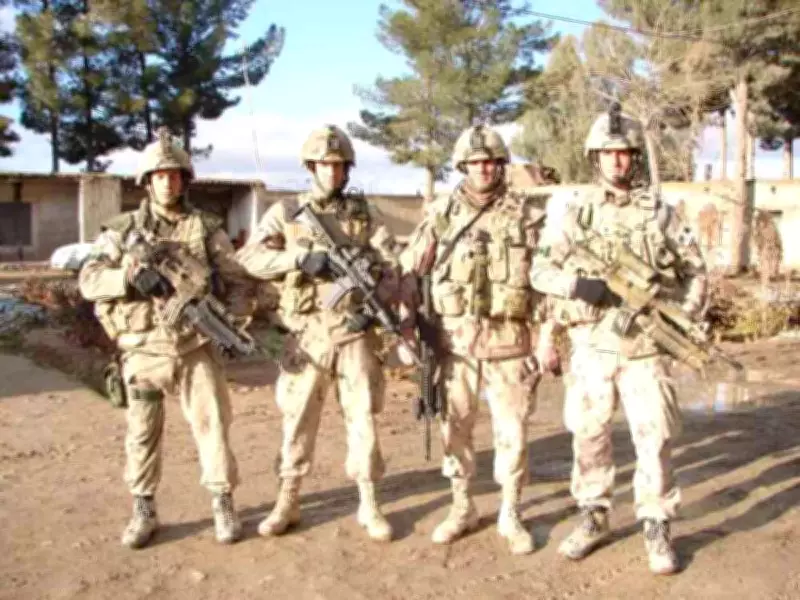
In a recent interview held in Davos, Switzerland, former U.S. President Donald Trump made controversial statements regarding NATO, claiming that the United States "never needed" its allies and had "never really asked anything of them." He further suggested that allied nations, such as those in NATO, merely "sent some troops to Afghanistan, or this or that," while staying "a little back, a little off the front lines." These remarks have sparked significant backlash, particularly from military veterans who have firsthand experience of international cooperation in conflict zones.
Canadian Military Sacrifices in Historical Context
Retired Canadian Brigadier General Serge Labbé, who served as a commander in various international missions, has stepped forward to set the record straight. Labbé points to historical data that contradicts Trump's assertions, highlighting the voluntary service of approximately 30,000 Canadians in the U.S. Armed Forces during the Vietnam War. Of these, 12,000 served in combat roles, with 134 making the ultimate sacrifice. In contrast, around 60,000 U.S. draft dodgers sought refuge in Canada during the same period, underscoring a complex bilateral relationship rooted in shared sacrifices.
Multilateralism and Coalition Building Under George Bush Senior
Labbé contrasts Trump's unilateral rhetoric with the diplomatic approach of former President George H.W. Bush, who served in the U.S. Navy during World War II and was awarded the Distinguished Flying Cross. In response to Saddam Hussein's invasion of Kuwait in August 1990, Bush senior meticulously built a coalition of 42 nations, supported by a UN Security Council Resolution, before launching Operation Desert Storm in January 1991. This coalition included diverse members such as Bahrain, Bangladesh, Egypt, Kuwait, Niger, Oman, Pakistan, Qatar, Saudi Arabia, Syria, Turkey, and the United Arab Emirates, representing the largest alliance since World War II.

According to Labbé, Bush senior's strategy emphasized that inclusive, multilateral interventions are more likely to succeed than impulsive regime changes or claims of unilateral dominance. This philosophy extended to the 1992 intervention in Somalia, where Bush senior sought a robust Chapter VII mandate from the UN Charter to authorize force, aiming to halt internecine fighting and facilitate humanitarian aid. One of his first calls was to Canadian Prime Minister Brian Mulroney, who agreed to redirect Canadian forces to support the U.S.-led coalition in southern Somalia.
Canadian Contributions in Somalia and Afghanistan
As Commander of the Canadian Joint Force deployed to Somalia in December 1992, Labbé assured U.S. Marine Corps Lieutenant General Robert B. Johnston that Canada sought a challenging role in restoring order. Canada deployed unique assets, including Sea King helicopters equipped with forward-looking infrared radar (FLIR), which were the only ones in the coalition capable of tracking ground movements at night. In early 1993, Johnston requested Canadian support for U.S. and Belgian forces in the port city of Kismayo, facing Somali militants.
Without hesitation, Labbé ordered HMCS Preserver, the support ship for the Sea Kings, to assist, despite temporarily losing a valuable asset for Canadian operations. Johnston later commended this effort in a letter to the Canadian Chief of Defence Staff, noting that the Sea Kings flew 22 FLIR missions over 11 days, playing a crucial role in stabilizing the volatile situation. This collaboration exemplifies the deep integration and mutual reliance among NATO allies in combat scenarios.
Refuting Claims of Allied Inaction
Labbé's account directly challenges Trump's implication that NATO allies have been passive or distant from front-line engagements. By detailing Canadian involvement in Vietnam, Somalia, and Afghanistan—where Canadian soldiers, including Labbé himself, served at Kandahar Airfield in 2007-2008—he underscores that allied forces have not only participated but have often taken on critical, high-risk roles. These contributions have saved American lives and bolstered coalition successes, demonstrating that the U.S. has indeed relied on and benefited from NATO partnerships.

In conclusion, Labbé's rebuttal serves as a powerful reminder of the historical and ongoing sacrifices made by Canadian and other allied troops. It calls into question narratives that downplay the value of international alliances, advocating for a renewed appreciation of multilateralism in global security efforts.