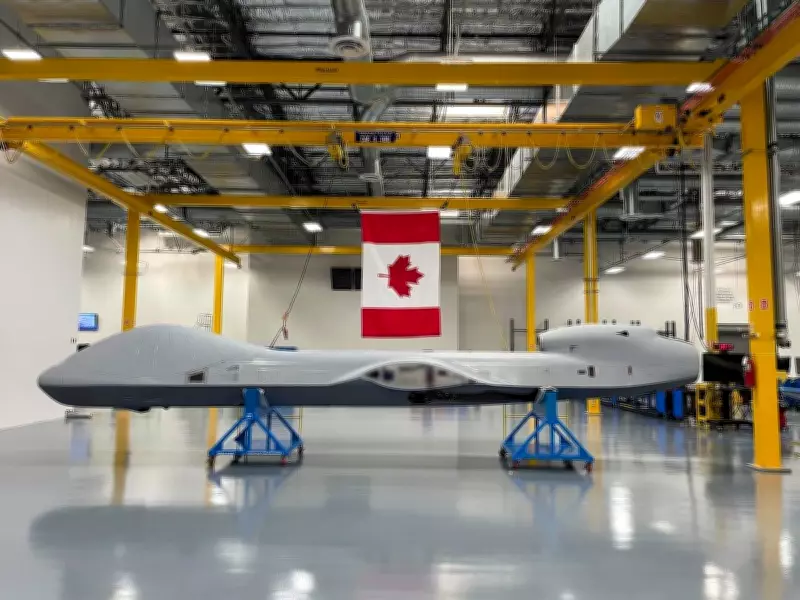
Canada's New Military Drones to Begin Service with Restricted Functions
According to internal documents obtained by the Ottawa Citizen, Canada's first MQ-9 Reaper drones will enter service with significantly limited capabilities when they become operational in 2028. The Department of National Defence confirmed the delivery timeline remains on track, but initial functionality will be constrained compared to original expectations.
Initial Operational Limitations Revealed
An unclassified briefing obtained through an access-to-information request indicates the first drone will only be capable of conducting "basic domestic ISR (intelligence surveillance and reconnaissance)" during its initial deployment phase. Notably, the aircraft "will not be carrying weapons" at launch and will lack communications interception capabilities.
Furthermore, the system will not be available on a 24/7 basis as originally anticipated, representing another significant limitation during the early operational period. Department of National Defence spokesperson Kened Sadiku confirmed these details while maintaining that the delivery schedule remains unchanged.

Full Capability Timeline and Program Details
The entire fleet of 11 MQ-9 drones is expected to reach full operational capability between 2030 and 2033, according to Sadiku. The Liberal government announced the $2.5 billion purchase from U.S. company General Atomics on December 19, 2023, with the aircraft to be stationed at 14 Wing Greenwood, Nova Scotia, and 19 Wing Comox, British Columbia.
The drones will be controlled from a facility in Ottawa and are intended for both domestic and international operations once fully operational. According to DND documentation, the General Atomics MQ-9B Reaper will eventually be used for:
- Overseas surveillance and attack missions
- Domestic sovereignty patrols
- Large event surveillance
- Natural disaster response support
Weapons Capabilities and Personnel Requirements
Another briefing on the Remotely Piloted Aircraft System (RPAS) program reveals that the drones will eventually be equipped with various weapons systems, including 250- and 500-pound bombs as well as "low collateral damage" bombs. These capabilities will only be integrated after the initial limited deployment phase.
Personnel requirements for the drone program have increased from the originally announced 240 personnel to 293 total staff. The revised staffing plan includes:
- 275 full-time military personnel
- 10 reservists
- 7 public servants
These personnel will staff the ground control centre in Ottawa and the drone facilities at both wing locations. No explanation was provided for the personnel increase.
Delivery Delays and Arctic Modifications
The drone delivery has been delayed from the original 2025 target to 2028 due to necessary modifications for Arctic operations. Department of National Defence spokesperson Andrée-Anne Poulin explained that operating at high northern latitudes requires specialized satellite and communication components not previously integrated on the MQ-9 platform.
"Additional testing and qualification work will be required to ensure the RPAS can be operated and maintained in Canadian climatic conditions," Poulin stated in a previous email. These modifications are essential for the drones to function effectively in Canada's challenging Arctic environment.